Showing posts with label frustration. Show all posts

July 12, 2022

I Never Thought I Would Say This

I thought the hardest thing I have ever done was to recover from a stroke.  A very close 2nd source of stress is moving to Michigan.  My single spaced To-Do List shows what I have to do in the next 4 weeks.    I have a 2nd To-Do List for selling my house.  😢    

In the 1st year after my stroke a gratitude list helped me deal with stress.  Each day I wrote 3 to 4 word phrases describing events that gave me 5 seconds of happiness.  Reading that list at the end of the day changed the way I felt about how my day had gone.  I hope writing a gratitude list now will help me cope too.  When I feel sorry for myself I also say "I am moving towards a time when I am happy and safe."

Thank God I started working on my move two months ago.  For example, I struggled to find ways to get rid of monstrously big furniture.  I am also glad I paid a woman to come one hour every week to do tasks that require two good hands.  Taking a table to the curb for my township to pick up is too much for me.  homeafterstroke.blogspot.com

June 3, 2022

Reasons for Letting Go

I am getting ready to move to an independent living facility in Michigan and have spent the last three weeks giving nice things to charity and throwing others in the garbage.  Living in 9 different residences in 5 different states over the years has given me plenty of practice with the process of letting go of objects.  Early moves when I was in my twenties taught me to think about getting rid of belongings that my husband and I never took out of boxes since the previous move.  

I am also motivated to let go by the high cost of facilities for old people.    I used graph paper to plot the small apartment I can afford and put my furniture in it.  I  learned I have to get rid of more than I anticipated.  Every piece of furniture has to do double duty.  For example, my small kitchen table will be used as a desk and a breakfast table.  My small bookcase will hold belongings I used to keep in the big buffet below and a big roll top desk.  My radio/CD player will sit on top of the bookcase. 

The payback for a stressful move is that I will be in a safe environment and be closer to my family.  homeafterstroke.blogspot.com

May 26, 2022

Open & Close Cereal/Bread One-handed

Opening and refolding the plastic bag inside a cereal box is a two-handed task.  I would have to use my teeth and my sound hand.  Instead I take the bag out off the box, cut one side open (see arrow), and pour the cereal into a container.  Each morning my sound hand flips open the lid and pours.


To open a loaf of bread, I pull off the plastic tag and use the pointy end of a bottle opener to rip open the inner plastic liner.  


To close, I fold the open end of the bag under the loaf (see arrow) and slide the loaf inside a bread container made by Rubbermaid.  When I turn the container upright, the weight of the bread keeps the folded end shut.  The next day my thumb flips the lid off, I put the container on its side, and slide the bread out.  homeafterstroke.blogspot.com

May 20, 2022

Downsizing Begins

After my visit to an independent living center in Michigan, the reality of downsizing became real. After I drew my furniture on a grid it became clear that the one bedroom apartment I can afford is too small for my beloved oak furniture.  For example, it took me two days to empty my desk and find a tiny alternative.  I am testing the efficiency of my new arrangement instead of waiting to figure it out as I unpack in a new environment.  It is better to find out now what I really need and what I can live without.  I took photos to help me remember the complicated new configuration.  homeafterstroke.blogspot.com


From 200 pound monstrosity to   
   

My old night stand

March 11, 2022

A Painful Lesson About Need versus Want

After driving 51 miles every morning in rush hour traffic, I love relaxing while I sip coffee and do a puzzle from the Simon & Shuster Mega Crossword Puzzle Book.  When I do not know the name of a Greek God or other obscure facts, I look up the answer in the back of the book.  I have the satisfaction of doing a challenging puzzle while also finishing it.  Unfortunately, painful osteoporosis in my sound hand threatens my ability to drive a car one-handed.

Using paratransit to stay in my home would be difficult.  NJ paratransit can require riders to wait 40 minutes to be picked up and sometimes ride for an hour while other riders are delivered to their destinations.  It also has a two bag limit which requires multiple trips to the grocery store.  If I cannot find a way to make writing less painful, I will have to choose between something I love to do and driving which I need to do.  

Two adaptive devices that increase the diameter of a pen to discourage a tight grip did not work.  The hard plastic cylinder on the right has a tiny opening that does not accommodate my pens.  The soft tube on the left requires my painful hand to forcefully push the tube up onto the pen while I hold the pen in my mouth.  More pain is counter productive.  
My current strategy to make writing less painful has four parts.               1. Use double-sided tape to attach sticky Dycem to my pen.                         Increased friction means I do not have to grip as forcefully.              2.  Use a gel pen that allows ink to flow at a variety of angles.  
     Ball point pens are finicky about the angle you hold the pen.

3.  Put 2 or 3 fingers on top of the pen instead of the usual one.                     More fingers = less effort for each individual finger.                            4.  Keep all my fingers as straight as possible.  Bending my fingers               increases the pain. 

homeafterstroke.blogspot.com

February 25, 2022

2nd Hardest Challenge to My Independence

Learning to drive a modified car is the hardest task I had to master after my stroke.  The 2nd hardest is dealing with the New Jersey ban on stores providing and selling disposable plastic bags.  Reusable bags sold in stores and on-line are big.  They hold a lot so they are too heavy for me to carry up my front steps.  They also do not nestle together in the rolling cart I use to transport bags from my car to my front door.  Section 1.18 of the law allows customers to use disposable bags so I reuse bags I have saved until they rip.  Going to a long-term facility because I cannot get food in my house is a severe consequence.  Meals-on-Wheels supplies only 2 meals a day Monday to Friday.

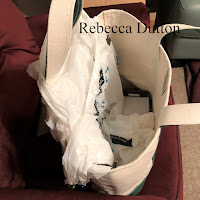
Solution # 1.  I carry my plastic bags in a canvas bag from LL Bean.  The small canvas bag was not tall enough to let the plastic bags hang down fully.  The large canvas bag sags.  The medium canvas bag with short handles is just right (see photo below).

Solution # 2.  I pre-bag a few items like a half gallon of milk and packages of meat that tend to leak.  I bring extra bags to shake open.      I place one handle over the metal arch shown in the photo.  Then I drop the item in the open bag.  This allows me to work at my own pace before I get to the check-out line.

Solution # 3.  When thin plastic bags are nested inside each other, the friction between bags makes several bags pull out at once.  Hanging them side-by-side vertically stops them from sticking together.  However, when I strung the handles of the plastic bags over the handles of the canvas bag it created a messy pile (see left handle).  I had trouble finding a handle that paired with its mate. 


So I weigh down one handle of each plastic bag with a big key ring.  I hang these key rings over the side of the canvas bag where they are easy to grab.  This strategy lets me quickly find one handle so I can pull the bag open, fill it, and lift it out of the canvas bag.


Solution # 4.  Bulky items like a box of cereal and a pack of toilet paper are hard to put in a small plastic bag.  I put a cereal box on the belt last so I can put it in the empty canvas bag which stays open because it is stiff.  For a pack of toilet paper, I make a hole in the top with my car key after I take it off the shelf.  I stick my finger in that hole to put the toilet paper on the belt and in my cart.

P.S.  I am grateful to a kind cashier at Shoprite named Michelle.  When no one was behind me in line Michelle waited patiently while I made numerous mistakes during multiple shopping trips.    The ban begins on May 4th.  I am glad I had all of February to find the solutions listed above.  Rehearsal saved me again.  homeafterstroke.blogspot.com

December 25, 2021

Are Sadness and Anger Bad?

The holiday season often evokes strong feelings.  I used to think positive emotions like joy and love are good while negative emotions like sadness and anger are bad.  Now I believe that how I react to my emotions is what is good or bad.  When I let moments of joy fly past me unnoticed because I am pre-occupied by internal mental chatter it is bad.  When I stop what I am doing and take a few seconds to appreciate when I am happy it is good.  When I rerun upsetting episodes in my head it is bad.  When I use anger to propel me towards a solution it is good.

When I was young I had the tremendous energy it takes to sustain emotional drama.  A stroke took away the energy I need to stay upset for a long time.  Being snubbed recently reminded me of how intense emotions can be.  I was upset the day I was snubbed.  By the next day -- not so much.        By the third day I remembered letting this person upset me gives her power.  By the fourth day I remembered I was upset for decades when I was young but can not remember most of what upset me.  Hence the irritating platitude -- this too shall pass.  

How I react to my emotions is a conscious choice, but I forget this again and again.  Fortunately, as I get older I remember this insight sooner and suffer less.  homeafterstroke.blogspot.com

November 28, 2021

Hard to carry over skills acquired during exercise

The transition from exercise to functional tasks can be difficult.  Functional tasks require clients to divide their attention between thinking about what their body is doing and watching what objects are doing.  For example, I kept dropping a tube of toothpaste until I realized only my thumb and middle finger contact the tube of toothpaste.  The photo shows this precarious grasp.  Dropping an open tube produces a splatter of sticky toothpaste on the floor.  So I press the end of the tube against my stomach to hold it still while I watch my sound hand remove the cap.   

Fortunately I have a strategy for dealing with my negative emotions when I fail during functional tasks. The first time I try a new task, one or more steps are difficult or impossible for me to do.  This means I cannot finish what I started.  To help me persist in the face of failure I call my first attempt a rehearsal.  The purpose of a rehearsal is to discover solutions that will make my second attempt awesome.  Waiting until the next day also gives me time to think of new things I can try next time.    homeafterstroke.blogspot.com


September 27, 2021

Organizing My Purse is a Vital Shopping Strategy

Trying to find something in my purse by digging around with one hand is awful.  Organizing my purse reduces frustration when I go shopping.  Every woman organizes her purse differently so my examples are intended to help stroke survivors realize a purse does not have to be a buzz kill.

I put my car key on a green wrist coil to make it easy to retrieve.  I grab the wrist coil instead of searching for the key.  I made the mistake of setting the key down to pick up an object on my car seat and then locking and shutting the door.  Seeing my car key on the dashboard was awful.  The AAA car service unlocked my car after I waited for an hour.  When I made this mistake a 2nd time I knew I needed the sensory cue of the coil around my wrist to tell me I have my car key before I get out of my car.                                                                                                My house key is on a straight flexible coil that is hooked on my purse.  All I have to do is pull on the coil to make my house key slip out my purse.   

I can handle credit cards quickly because I keep them in a zippered compartment that holds only a driver's license, one credit card, an ATM card, and a library card.  While sitting in the parking lot I place the card I need vertically so it stands out from the other cards which are horizontal.  Cards go back in this zippered compartment in a flash.  Less frequently used cards like my health insurance card are in another compartment.    homeafterstroke.blogspot.com

August 3, 2021

I Take My Brace Out of My Shoe Twice a Year

Putting my foot in my brace and then putting my brace in my shoe with one hand is insanely difficult.  Instead I leave my brace in my shoe except twice a year when I transfer it between my black shoes for winter and my tan shoes for summer.

My sound hand grasps the tongue of the shoe and I let the weight of the brace swing the shoe up in the air.  I hook my hemiplegic elbow behind my knee to help lift my hemiplegic leg so I can put my toes partway in the brace.  Finally I put the shoe down on the floor and press downwards to slide my foot in the rest of the way.  No swearing required.  homeafterstroke.blogspot.com

May 9, 2021

Rolling Over in Bed Can Be a *****

Right after my stroke, rolling over in bed took horrendous effort when I was most tired.  When I rolled onto my sound side, my floppy hemiplegic arm would get stuck behind me.  It felt like a wrestler was pinning my upper body to the bed.  I had to remember to use my sound hand to pull my hemiplegic arm across my chest before I started to roll while pulling on the bed rail.

Seventeen years later rolling onto my sound side is still difficult.  One night when I wanted to roll over so I could sleep on my sound left side, my hand reached for the folding chair I placed next to my bed.  This chair is lower than my bed which makes it easier to lean down to tie my shoes.  With the help of the chair and a hemiplegic arm that now rolls with the rest of my body, I quickly fell asleep.  Once again serendipity made my life better.   


However, I have gotten good at rolling onto my hemiplegic right side to get out of bed.  My sound arm crosses over my chest as I swing my sound leg over my hemiplegic leg.  My sound hand reaches for the mattress as I hang both legs over the edge of the bed.  The weight of my legs dropping down helps pull my trunk and head up.  My sound hand pushes on the mattress to help me sit up.  homeafterstroke.blogspot.com

May 4, 2021

The Whacky Grasp That has No Name

My sound hand can place small objects between the index and middle fingers of my affected hand so this hand can hold objects still.  As an OT I know this is a weird grasp that has no name.            As a stroke survivor it makes me really happy.


The index and middle fingers of my affected hand can hold a toothbrush so my sound hand can squeeze toothpaste on the brush.  


The index and middle fingers of my affected hand can hold a cotton swab still while my sound hand cuts it in half.  This creates smaller pieces of cotton I put in my ears before I use hair spray on my short hair. 


I use my teeth to pull a rubber glove on my sound hand.  I do not want to touch shopping carts and transfer what my hand picked up to my car key, car door, and steering wheel.  When I get my groceries to my car, I use my teeth to pull the glove off inside out.  I do not want to leave a dirty glove in the cart so I place it between the index and middle fingers of my affected hand.  
I unlock  my car door and put the used glove in a cup in my car.
Then I put my groceries on my back seat.  

homeafterstroke.blogspot.com

April 27, 2021

Saved by the 80% Rule

Ironing aprons after the Spring Sale at my church reminded me of a pleasant childhood memory.  I remembered when my mom taught me to iron by having me iron handkerchiefs.  This was a simple task I did successfully the very first time.  However, it is easier to get wrinkles out of a handkerchief than an apron.  Fortunately these aprons do not have to be ironed perfectly because they will be stacked in a box until next year and will come out a little wrinkled anyway. 

This got me thinking about the 80% rule.  Business managers use the 80% rule to keep down costs.  Some tasks that are 80% correct do not affect the bottom line while others have to be closer to perfect.  The rule says you need to think about striving for perfection because the last 20% requires nearly as many resources as the first 80%.  Business managers are paid to decide when a company should spend extra resources to approach perfection.  I wish I had known about the 80% rule when I was married.  When my husband did not smooth out the bedspread perfectly I would have known  this is an acceptable business practice.

I do not know where I got the idea that ALL work has to be done perfectly ALL the time.  I used to be a perfectionist, but now I think perfection should be a conscious choice rather than a habit.  
I live alone so when I am exhausted or frustrated I use the 80% rule.  homeafterstroke.blogspot.com

April 11, 2021

New Strategy for Obnoxious Able-bodied People

While struggling to get my sound arm out of the sleeve of my coat today, I thought about able-bodied people who insist on helping me.  People who grab an object out of my hand make me angry.  The last time I was treated this way I was 18 months old.  Nothing I have said has stopped people who insist they can quickly do what I am trying to do.  They are uncomfortable watching me struggle so they assume I am frustrated.  But struggling gives me confidence.

Let me give you an example.  I have never gone to bed with my coat on because I live alone.  Instead of feeling fear when I walk in my door, I relax because I know repeatedly wiggling my sound arm will get that arm out of its sleeve.  I know this because this strategy has never failed.  The next time an able-bodied person insists on helping me, I am going to tell then they are stealing an opportunity for me to have faith in persistance.  homeafterastroke.blogspot.com

March 3, 2021

The Final Shoe Solution

Being forced to stay home during the covid-19 pandemic helped me remember why I work so hard to solve problems caused by my leg brace and shoes.  I would be severely depressed if I had lacked the confidence to walk safely in the community during the 16 years since my stroke.

Neither the white duct tape in the photo or double-sided tape have glue strong enough to stop my leg brace from pushing the shoe insert out of place.  When the shoe insert slides to one side my foot tilts so most of my weight is on the outside edge of my hemiplegic foot (ankle inversion).  Walking on a foot that is not flat is unsafe and tiring.  I am currently using T-Rex Ferousiously Strong double-sided mounting tape to see if it keeps the shoe insert in the center of the shoe.

Long socks that reach the knee prevent skin chafing as the brace rubs the top of the calf.  However, the only knee-high socks made for women are brightly colored socks used during soccer.
I cut the top off a man's white tube sock so it covers the top my calf.  I have washed them many times.  They fray eventually but hold together for a long time.  I am happy that what people see is black socks with black shoes and beige socks with beige shoes.


My THICK leg brace creates a leg-length discrepancy by making my hemiplegic leg longer than my sound leg.  Wearing 2 socks on my sound foot makes my sound leg a little longer.  The 2nd sock also keeps my foot from sliding inside the extra wide shoes
I need to accomodate my brace.  Having my sound foot slide inside my shoe makes walking tiring and puts strain on my hip and knee.  I wish I had known about this 2 sock solution before my sound knee needed joint replacement surgery.


The long sock I pull over the short ankle sock gets stretched out which makes it easier to don.  I bought permanent ink pens to mark the stretched sock in each pair.  A black pen works for white and beige socks.  The silver pen I use on black socks fades in the wash so I have to repeatedly mark them.

If you read this entire post you may understand why I do not think this is my last post about my shoes.   homeafterstroke.blogspot.com

September 19, 2020

Cheap Equipment That Prevents Spills

Stroke survivors can prevent messes when they cook by using cheap objects instead of buying expensive adaptive devices from a medical catalogue.  For example, my hemiplegic (paralyzed) hand cannot reach up and hold the handle of a pot to keep the pot still when I stir food or flip food with a spatula.  So I slide pots off the burner onto a heat-resistant fabric hot pad before I stir or flip food.  Friction has always kept the pot still.  Now I use a cheap silicon hot pod to hold things still (see below).

An even more delicious way to save money is to use the plastic lid from a peanut butter jar.  This lid catches spills when I measure spices or messy food like olive oil.  It is frustrating to stop to clean up a mess I just made on my counter top.  Using spices is a matter of life-and-death because I am on a low salt diet to help control my high blood pressure.  Low salt food tastes awful without lots of spices.  homeafterstroke.blogspot.com

September 3, 2020

Cheap Equipment That Reduces Frustration

A cheap seam ripper I bought at a sewing goods store got rid of a ton of frustration.  I open seals around the top of bottles by slipping the point of the seam ripper under the edge and ripping upwards or downwards.  Then I pull off the seal by grabbing the cut edge with my sound hand while I squeeze the bottle between my thighs.  Sometimes I grab the cut edge with my teeth as my sound hand holds the bottle.  No more trying to slice with the tip of a knife which shreds rather that cuts.  


I use the tip of the seam ripper to rip open the foil at the top of a pill bottle and dig out the cotton ball that fill half of the bottle.  Preventing decades of frustration is not a small thing - so much energy saved for better things. homeafterstroke.blogspot.com

August 11, 2020

Safety Precautions Rocket Me to Independence

I am divorced, was not able to have children, and have one brother who lives 800 miles away so I am more likely to end up in a nursing home than some stroke survivors.  Fortunately, precautions that facilities use to keep people safe propelled me to independence.  In the rehab hospital I made the mistake of wheeling myself out to the patio when I was done with therapy for the day. The aide who was sent to find me said I could not sit outside alone.  When I pointed to people who were sitting alone she whirled my wheelchair around and took me back to my room.  The last time I was dragged inside I was probably three years old.  A psychologist said the staff were afraid I would wander off if they let me go outside, but he brokered a compromise.  I could sit outside if I came back upstairs and wrote down where I was going on a clipboard. 

Safety precautions are good.  The problem is staff who rigidly apply precautions to everyone. 
Did anyone read my chart to learn I had a stroke in the back of my brain (brainstem) instead of the cortex where cognitive functions are located?  I was treated like my roommate who was so confused she tried to use the TV remote as a telephone.  The staff attached a sensor to me at night to keep me from getting out of bed.  Every time I rolled onto my side I triggered a very loud alarm and had to wait for an aide to come shut it off.  When I finally complained, a nurse said they would stop using the sensor if I signed a release form saying they were not liable if I fell out of bed.  How long they would have used it if I had not objected? 

When I toured an assisted living facility I was upset again by procedures designed to keep people safe.  The director who gave me a tour said "elderly people prefer to have a nurse give them their medication."   If a nurse dispensed my pills, my day would revolve around visits to the nurse because I take pills three times a day.  I am not living in an apartment if the nurse can open my door with a master key to give me my pills if I sleep in.  homeafterstroke.blogspot.com

August 4, 2020

Some People Invade My Personal Space

I snapped at a dear friend when she offered to retie my loose shoelace.  Even though I said I could do it, she insisted on helping.  This made me angry because every doctor I have seen since my stroke reaches down to untie my shoes during a physical exam.  They do it quickly because they know it is not appropriate for a male doctor to undress a female patient.  I do not know how old I was when I decided my clothing is a part of my personal space, but it was a long time ago.

Telling my friend I could do it as fast with one hand as she could do it with two hands was not a deterrent.  She said "I could tie your shoe at least once so you won't have to."  My strategy to handle this more gracefully next time will be to say "Can you tie a shoelace that has only one free end?"  homeafterstroke.blogspot.com

August 3, 2020

Nails Do Not Stop Growing After a Stroke

         CAUTION: CLIPPING NAILS REQUIRES GOOD SENSATION AND COORDINATION

I live alone so I have to cut my nails.  I cut the nails on my sound hand by using an adapted nail clipper.  The end of the large nail clipper has a square handle which is comfortable for my palm to press on.  The long handle also gives me good leverage when I push down.      I returned the small nail clipper.  The V-shaped end dug into my palm when I pushed down.  The short handle meant I had to press hard to get enough force to cut my nail.

The large nail clipper has emery boards held by pegs that are tightened by hand.  I use these emery boards to remove sharp points at the corners of my nails. This is safer than trying to get the clipper into these tight spaces.  The clipper came with four emery boards, but replacing them is a challenge.  All the stores near my home sell only wide, thick boards (see pink board) that do not fit in the clipper.  The Internet sells long emery boards except for this link.

My sound hand uses a regular nail clipper to cut nails on my affected hand.  Spasticity in my affected hand makes my fingers curl.  To straighten them, I prop them one-at-a-time on a the edge of an opened drawer.  The open drawer allows my sound hand to get low enough to get a good cutting angle.  I put a piece of non-slip shelf liner under the finger to keep it from slipping, but the shelf liner got in the way when I photographed my hand.


Bottom Line: I cringed when I learned the large nail clipper costs $37.50, but nails do not stop growing so I do not have a choice.  homeafterstroke.blogspot.com