Showing posts with label snow strategies. Show all posts

December 18, 2021

Walking in Snow with a Cane

Warning: I do NOT use my cane to walk through snow.  I wait until a neighbor I pay shovels my walkway and digs out my car.  I must be able to see the ground to tell if there is an icy patch that could make the spikes of my Briggs Ice Cane/Crutch Attachment slip.  Checking the ground for ice slows me down, but it gets me to my car safely so I can drive.

The photo shows the attachment in the up position to keep it out of my way.  I bought it at a medical supply store near my home.  The advantage of buying it in a store instead of on-line was the saleswoman got out a screwdriver and fastened the device to my cane.  


To lower the prongs, I place the cane in my affected hand and my sound hand pushes the device down until I hear it snap into position.

The device makes my cane slightly heavier which slows me down which is not as bad thing.

I use a different cane during warm weather rather than take this device off and try to put it back in the same place each winter.  homeafterstroke.blogspot.com

March 3, 2021

The Zipping Challenge is Not What You Think

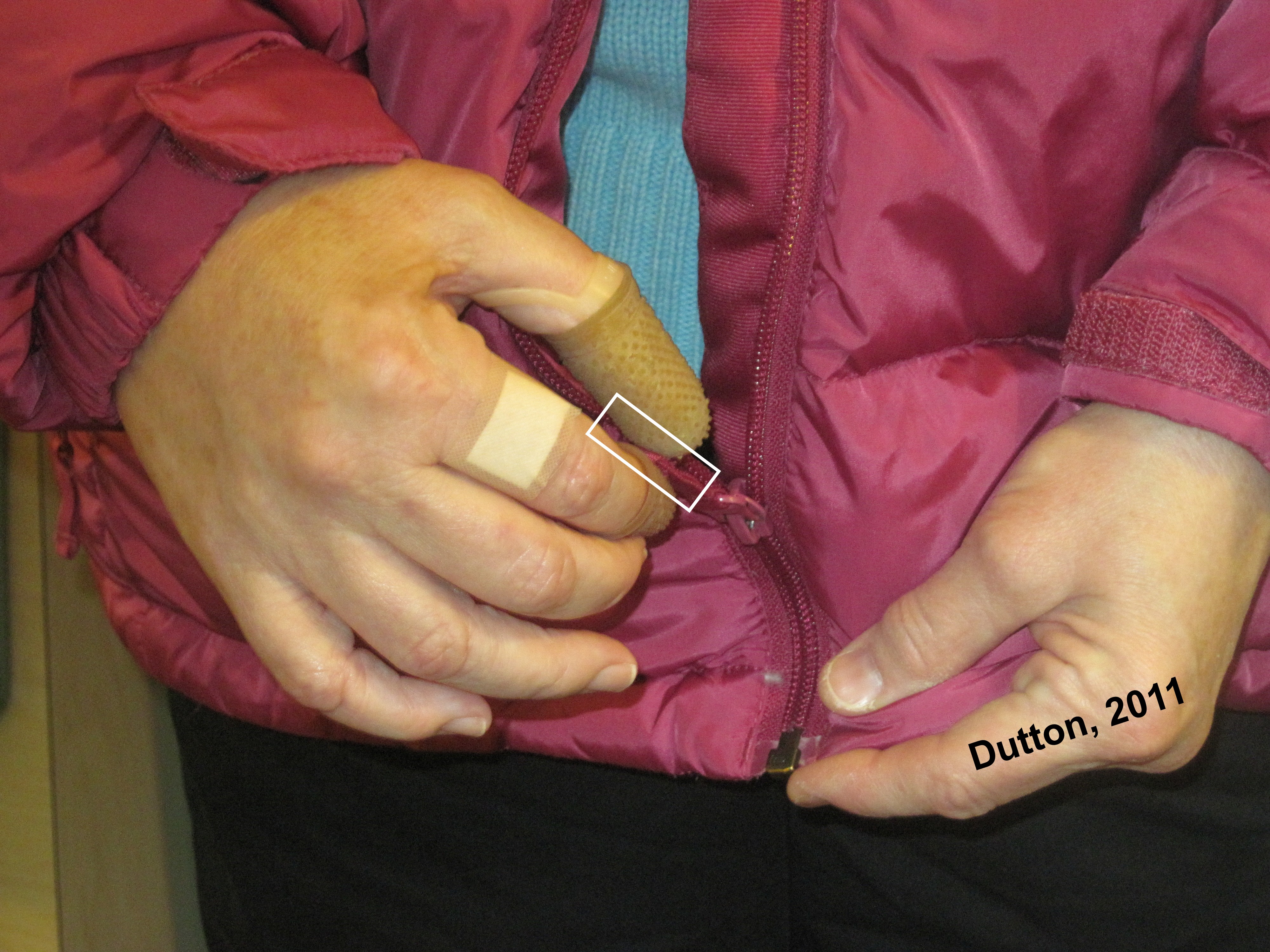
Velcro tabs do not keep me warm.  When I sit in the car, gaps form between the Velcro tabs which lets body heat escape.  Connecting the two halves of the zipper are relatively easy.  My right affected hand only needs a gross grasp to hold the female end of the zipper still while my left sound hand inserts the male end in its slot.                                                                            Challenge #1.  Zipper teeth do not mesh together if they are not perfectly aligned.  Only my sound hand can keep the two sides of the zipper perfectly aligned after they are joined so I can zip my coat  (see next 2 photos). 
Arrows show my sound index finger pushing up on the bottom of my coat to keep the zipper joined.  My sound thumb and middle finger pinch the bottom of the coat to hold it still as I  zip.  My affected hand pulls on the fabric zipper tab (white rectangle).     

After I broke my forearm I lost the tip pinch needed to grasp the fabric tab on the end of the zipper.  I attached one end of a tiny carabiner in the hole of the metal zipper tab (S-biner, size 2 from Home Depot).          I insert my hemiplegic index finger in the other hole of the carabiner and pull the zipper up a few inches.  The top photo shows my current coat has a zipper ring so I no longer need a carabiner.

Challenge #2.  My affected hand can pull the zipper tab up only two inches.  Going higher forces my wrist to bend due to the flexion synergy.  After two inches I switch hand positions.  My affected palm presses against my stomach to keep the bottom of the coat still while my sound hand finishes the zipping.  I unhook the carabiner and put it in my coat pocket so it is not visible at front of my neck.  homeafterstroke.blogspot.com

February 25, 2021

Snow Shoes for a Stroke Survivor

Since my stroke I am careful about venturing outside when it snows, but I am not trapped inside until spring.  Once streets are plowed and sidewalks shoveled, I wear boots over my shoes to give me better traction when icy slush is left behind.  Boots also help when my car is covered with snow.  Dragging snow off my car dumps snow on my boots instead of my shoes.  Boots I tried on at a shoe store would not fit over my leg brace.  My leg brace does not allow me to point my toes which is a pre-requisite for donning boots.  On-line I found the Neos overshoe with a Velvro opening that goes all the way down to my toes.  The Villager model is lightweight and designed for occasional use which is perfect for me.  I walk more slowly with boots on, but that beats not being able to get to the grocery store or keep important appointments, like a doctor appointment.
Notes-to-Self.  1) Make the ankle straps long BEFORE I take the boots off.  Long straps make it easier to unsnap and snap the plastic buckles. After snapping the buckle closed, pull the end of the strap to make it tight.  2) Begin by opening the boot ALL the way to the toe so I will not have to wrestle with the nylon fabric to get my toe in the boot. 

A video at www.overshoesonline.com shows how to don this boot.
Warning #1: I do not put the boots on while standing as the video shows because I do not have good standing balance.  My boots go on safely while I am sitting.  Warning #2: The first set of boots I ordered was too big so they flopped around when I walked.   homeafterstroke.blogspot.com