Showing posts with label basic ADLs. Show all posts

July 28, 2022

Toilet Training is a Disaster

OTs evaluate how clients get on and off the toilet.  However, aides are the ones who deal with dressing and undressing during toileting.  Aides have large caseloads so they speed up toilet time by doing everything for their clients.  This assistance masks safety issues.  

Small weight shifts while pulling my pants up threw me off balance.  I had to repeatedly twist my trunk so my sound could reach across the front of my body to get my underpants over the paralyzed hip and reach behind me to get my underpants over the paralyzed hip in back.  Continue to twist when I pull my pants up over my affected hip.  It took 2 weeks for my standing balance to improve enough for me to feel safe when I pulled my pants up without an aide in the bathroom

Toileting also requires repeated turning.  After I walk into the bathroom I have to turn 180 degrees to close the door at home or a doctor's office.  I am facing the door I just closed so I have to turn 180 degrees to walk to the toilet.  When I get to the toilet I have to turn 180 degrees so I can sit down.  I have to turn 180 degrees after I stand up so I can flush the toilet.  

OTs do not evaluate gait in the bathroom because ambulation is PT's domain.  PTs do not evaluate standing balance while twisting the trunk and repeatedly turning 180 degrees because toileting is OT's domain.  Yet needing 24 hour assistance for toileting can lead to a nursing home.  This is a severe consequence so OTs and PTs need to stop worrying about stepping on each others toes.  homeafterstroke.blogspot.com

May 12, 2022

Lucky Shoes

I never win lotteries or raffles so I was stunned when I had good luck finding a discontinued shoe I bought repeatedly for 18 years.  My brace man trimmed my leg brace to fit the shoe shown below.  Buying the same shoe over and over meant I never had to try on shoes to see if they fit.  On a lark, I went to the shoe store I have been using for 18 years and asked if they had this shoe stashed in the back even though it is no longer made.  I was stunned when the salesman walked out of the back room swinging 2 boxes with a grin on his face.  They were not only size 6 double wide, they were the beige color that goes with everything.  He was glad to sell them and I was thrilled to delay wondering if my brace would fit a new shoe. homeafterastroke.blogspot


May 4, 2022

Equipment that is WalMart Cheap

As an OT I shopped in expensive medical catalogs.  Now I use a cheap over-the-door plastic hook to hang a terry-cloth bathrobe on a towel bar.  Another plastic hook keeps the head of the shower hose off the floor of my tub when I am finished showering.

If I did not have non-slip shelf liner under the pill container it would start slipping away from me as soon as I reached in to get a pill.  I am glad non-slip shelf liner comes in neutral colors that do not clash with my decor because I have small pieces of it all over my house. 
                                                      homeafterstroke.blogspot.com

April 27, 2022

Bathing When I Travel

I am traveling at the end of April.  I have not used this shower stool for 4 years so I practiced using it home before I left.  Rehearsal always gives me confidence. 

Caution.  This stool may not be safe if you need assistance to stand up or sit down or are heavy.

It is not safe for me to stand in the shower.  When I travel I use a folding shower chair.  This adaptive device allows me to visit with family and friends and present at conferences.  I bought the stool at a local medical supply house. Before I bought it I wanted to see if I could open it myself and sit on it to feel how sturdy it is.    It is too big for anything but the widest luggage so a luggage saleswoman suggested I transport it in a nylon garment bag.

When I travel I cannot count on towel racks being close to the shower.  Before I get in the shower I check to see if the toilet is close to the shower.  If it is far away I drag a chair from the bedroom and place it close to the shower.  Then I open a towel and put it on the closed toilet seat or chair.  This gives me a clean place to sit after I get out of the shower.  I also put a folded towel on the closed toilet lid or a chair so I can dry myself.  After I am dressed I take the stool out of the bathtub.  I fold the stool and place it on the towel covered toilet seat and use the ends of the towel to wipe off the water.  homeafterstroke.blogspot.com

March 3, 2022

Reviewing Adapted Knives

When I eat out I order soft food that can be cut with a fork, like fish and pasta.  At home I have rocker knives that let me press down on the food to hold it still while a rocking motion cuts the food.  The small knife on the left in the photo looks like an assassin's weapon so I use it at home to cut vegetables.  The long knife on the right is the most commonly used one.  The photo below shows that this rocker knife does not fit in my purse.
I use an across-the-body purse because straps slide off my shoulder. When I was able-bodied I had a free hand to keep pushing the strap back up.  I found a small purse called the Terrace Shoulder Pouch at ebag.com.  The long knife sticks up so people can see I am carrying a knife - not good.   

I love Verti-Grip Professional Knife from caregiverproducts.com.
It is held vertically so my whole arm can press down as I rock the blade side-to-side.  The rocker knives shown above are held horizontally so I can only create downwards pressure with my index finger. The Verti-Grip is only six inches long so it fits completely inside my purse.  The protective cover slides off easily so I put the knife in a small zip-lock bag to protect the inside of my purse.  The Verti-Grip costs $17.95 + S&H, but I think it is worth it.  homeafterstroke.blogspot.com

January 15, 2022

Relacing Shoes One-handed

Yesterday's post about tying shoes one-handed means I did not have to push a wheelchair across carpeting with one hand and one foot when I got home.  The door jambs in my house also do not have gouges because it is hard to keep a wheelchair going straight when you do not have 2 hands.

Relace the Shoe: There can be only one free end at the top when you tie shoe laces one-handed.  I have the lace come out of the top hole on the same side as my affected foot.  This dictates which bottom hole I lace through first.    

Adjust Length of the Lace: I wear a leg brace so I need the full length of the shoe lace on my affected foot.  However, the shoe on my sound foot closes more tightly so I cut off 3 inches before I relace the shoe.  Trimming the bottom means I do not have excess lace at the top of this shoe.

Make an Anchor Knot: I put the lace through the bottom hole, leaving a 6 to 8 inch tail hanging out of the hole.  The "tail" gives me something to wrap around my affected hand so I can hold the lace while my sound hand makes a double knot.  I place one knot on top of each other rather than two side-by-side knots like pearls on a necklace.  A scout leader told me this sailing knot holds against great pressure.  Sometimes I leave the plastic aglet at the end of the lace and sometimes I cut it off which creates a tiny fuzzy pom-pom.  Both tuck out of sight (see bottom hole in photo above).  homeafterstroke.blogspot.com.

January 14, 2022

Tying Shoe Laces One-handed

It broke my heart when I saw a photo of the big toe nail Dean lost because loose Velcro fastenings allowed his feet to slide in his shoes.  I do not want sliding motions when I walk because my hips already hurt from time to time.  I am glad I can tie my shoelaces tightly with one hand (1).        Staying out of a wheelchair is definitely worth the effort.  

Tighten the Lace: If the holes in your shoes are punched through the leather, friction holds the lace in place after you pull on it and let go.  

The lower part of my shoe has D-rings (see bottom of arrow).  At the topmost D-ring I pull the lace tight and then maintain the tension by pressing down with my little finger.  Then I use my thumb and index finger to pull the slack (arched part of lace) through the next hole.        I pull the lace tight in the remaining top holes.


Make a Half Loop:  First my last 3 fingers grab the free end of the lace.  Then I slip my index under the top horizontal lace so my index finger is pointing back at my body.  This allows me to drag the lace under the horizontal lace to create the loop seen in the next photo.
Tighten Lace at Top Hole: The top horizontal lace is loose because my finger was under it so I pull to tighten it (see arrow).  Then I make the messy looking loop neater like in the photo.


Make a Slip Knot: My hand looks fisted while I grab the free end of the lace with my last 3 fingers.          I use my thumb to push the lace through the 1st loop (see arrow) that I created in the photo above.  This creates a 2nd loop.  I pull my thumb free and vigorously yank the loop sitting on the index card from side-to-side to tighten it.  


See tomorrow's post for how I relace my shoes so there is only one free end at the top.  homeafterstroke.blogspot.com

1. Dutton.R.  My Last Degree: A Therapist Goes Home After a Stroke, 2nd ed. Booklocker; 2013. 

November 11, 2021

Donning a Bra One-Handed

Women with small breasts have the last laugh.  I need a bra because my large breasts are closer to my waist than I thought was possible.  Being able to don a bra means I do not have to go to dinner at a friend's house and say "Could you fasten my bra when I get there."  Living alone makes social occasions a source of happiness I do not want to give up.

In sitting, I put the hook end in front of my stomach.  To keep the bra still, I fasten a clothes pin to the hook end and tuck the free end of the clothes pin under the elastic band of my underpants.  Then I flip the free end of the bra behind me until both ends are in front.          I hook the 1st hook, remove the clothes pin, and hook the remaining clasps.  It it not enough to rake the hooks over the clasps.  I have to press down on each clasp to make it slip under the hook.  I turn the bra around and put my arms* in the straps.  Then I lean over to get my breasts fully in the bra cups.   
*Putting bra on - affected arm goes in first.  Taking bra off - affected arm comes out last.

In the winter, I keep the bra straps from repeatedly slipping off the dry skin on my shoulders by putting a small dab of lotion on a Kleenex tissue.  Then I use a Q-tip swab to transfer the lotion to the top of each shoulder.  Aveeno lotion with oatmeal creates friction.  In summer when my skin is dewy with sweat, it is easier to turn the bra around if I shake a light coating of corn starch along the bottom elastic band before I don the bra.  homeafterstroke.blogspot.com

August 28, 2021

ADLs Are Where the Repetitions Are

Brain plasticity is amazing, but rewiring the brain requires thousands of repetitions.   Activities of Daily Living (ADLs) are a great way to get those reps. The examples below show why three sets of ten each day cannot compete with ADLs.

1) Twice a day I open my affected hand to grasp a tube of toothpaste so my sound hand can remove the cap.  My affected hand opens again to hold the tube while my sound hand puts the cap back on.  In nine years I have opened my hand over 5000 times before brushing my teeth.


2)  Shopping is therapy for my hand.  I open my affected hand to let go of the cart to reach for items with my sound hand.  My affected  hand opens a 2nd time when I grab the cart to move on. My affected hand opens a 3rd time so I can empty the cart in the check-out lane and again to load food into my car.  Pick uping 30 items + empty cart + load car means I open my hand 60 + 2 + 2 = 64 times.  64 x 2 visits a week x 9 years means I have opened my hemiplegic hand 59,904 times in the grocery store.

3)  The distance I have walked at the grocery store is huge.  I step away from the shopping cart and bend down or reach up to get items I want.  The curves I make to detour around people and other carts require more steps than walking in a straight line.  According to my pedometer I walk 2,000+ steps each time I visit the grocery store.  2,000 x 2 visits a week x nine years = 1,872,000 steps!
homeafterstroke.blogspot.com

August 4, 2021

Practical Guide to Giving Assistance

Activities of daily living (ADLs) evaluations divide assistance into mimimal, moderate, and maximal.  The Functional Independence Measure defines these levels by the percentage of a task a client can do independently like 25 - 49%.  OTs can guesstimate these percentages because they see hundreds of clients which helps them judge a client's performance.  Caregivers need a more practical way to know how much to help.

Minimal assistance = you can multitask because your loved one can do a lot, but stay near by.      Moderate assistance = sit or stand in front of loved one because they will need repeated help.  Maximum assistance = look for ways for your loved one to help you ( e.g. have them put their arm around you to help you scoot them to the front edge of the wheelchair before you stand them up).

OTs have an incentive to keep their hands in their lap - every time they help it lowers a client's ADL score.  Caregivers have different incentives for waiting to see how much their loved one can do.  Caregivers need energy to do chores their loved one usually does, like cleaning toilets and mowing the lawn.  Caregivers also need energy to make doctor and therapy appointments, arrange transportation, deal with health insurance bills, pick up medications, set up home exercises, and deal with a loved one's difficult emotions. 

When therapists say a client needs assistance, caregivers need to think about asking for help before they get into trouble.  Nurses gave caregivers a preparedness questionnaire before discharge from rehab and asked them what they were thinking as they answered each question (1).  A dialogue is much better than a handout.  homeafterstroke.blogspot.com

1. Carmicia M, Lutz B, Harvath T, Joseph J.  Using the Preparedness Assessment for the Transition Home After Stroke Instrument to identify stroke caregiver concerns predischarge: Uncertainty, anticipation, and cues to action.  Rehabilil Nurs.  2021;Jan-Feb 46(1);33-42.  

August 3, 2021

I Take My Brace Out of My Shoe Twice a Year

Putting my foot in my brace and then putting my brace in my shoe with one hand is insanely difficult.  Instead I leave my brace in my shoe except twice a year when I transfer it between my black shoes for winter and my tan shoes for summer.

My sound hand grasps the tongue of the shoe and I let the weight of the brace swing the shoe up in the air.  I hook my hemiplegic elbow behind my knee to help lift my hemiplegic leg so I can put my toes partway in the brace.  Finally I put the shoe down on the floor and press downwards to slide my foot in the rest of the way.  No swearing required.  homeafterstroke.blogspot.com

June 28, 2021

The Gift That Keeps on Giving

In the hospital my PT had me reach down with my sound hand to pick up cones sitting on a stool and stand up to place the cones on a shelf at head height.  I saw the value of this exercise when I started to wobble less as I reached down to pull up my pants at the toilet. I could not go home if I needed 24 hour assistance for toileting.  When Michelle did not have me squat in the morning,
I asked to do it in the afternoon.  After I went home activity analysis helped me identify how squatting keeps me safe during dozens of tasks.  Activity analysis is the gift that keeps on giving because it tells me WHY I WORKED SO HARD.

   I bend my knees and hips when I reach down to:
* Pull up my underwear and pants after toileting
* Pick up my cane after it has fallen on the floor for the thousandth time
* Get clothing out of the bottom drawer of the dresser
* Get shoes from the floor of the closet
* Get a milk carton sitting on the bottom shelf of the refrigerator
* Get a box of cereal from the bottom shelf of a kitchen cabinet
* Get a heavy pot from the bottom shelf of a kitchen cabinet
* Get a box of dishwasher detergent from under the sink
* Take a heavy book from bottom shelf of book case
* Plug a cord into a low electrical outlet 
* Pull clothes out of the dryer
* Use a garden hose to fill a watering can that is sitting on the ground
* Empty a waste basket
* Pickup a bag of garbage to take it to the outdoor garbage can
* Pick up purchases sitting on the floor of my car

P.S. Reaching down by bending at the waist with straight legs is hard on my arthritic low back.
homeafterstroke.blogspot.com

June 16, 2021

Qualifying for Disability Benefits

I was surprised to learn that having a stroke was not enough to establish my need for paratransit.  When I had an interview with paratransit services they asked me to give examples of why I could not take a regular bus.  My sound hand has to manage a cane and my hemiplegic hand cannot insert money in the fare box.  If I do not sit down quickly, the lurching movement of the bus would make me fall because I have poor balance.

Approval for social security disability (SSD) also required explaining how specific deficits interfered with my ability to do specific job related tasks.  Being one-handed meant I could not demonstrate or help OT students perform bimanual therapeutic techniques.  The physiatrist who filled out his section of the SSD application form was able to document my inability to perform functional tasks because he heard therapists talk about me in team meetings.  Neurologists do not evaluate or document the loss of independence that is needed to qualify for disability benefits.  homeafterstroke.blogspot.com

May 9, 2021

Rolling Over in Bed Can Be a *****

Right after my stroke, rolling over in bed took horrendous effort when I was most tired.  When I rolled onto my sound side, my floppy hemiplegic arm would get stuck behind me.  It felt like a wrestler was pinning my upper body to the bed.  I had to remember to use my sound hand to pull my hemiplegic arm across my chest before I started to roll while pulling on the bed rail.

Seventeen years later rolling onto my sound side is still difficult.  One night when I wanted to roll over so I could sleep on my sound left side, my hand reached for the folding chair I placed next to my bed.  This chair is lower than my bed which makes it easier to lean down to tie my shoes.  With the help of the chair and a hemiplegic arm that now rolls with the rest of my body, I quickly fell asleep.  Once again serendipity made my life better.   


However, I have gotten good at rolling onto my hemiplegic right side to get out of bed.  My sound arm crosses over my chest as I swing my sound leg over my hemiplegic leg.  My sound hand reaches for the mattress as I hang both legs over the edge of the bed.  The weight of my legs dropping down helps pull my trunk and head up.  My sound hand pushes on the mattress to help me sit up.  homeafterstroke.blogspot.com

May 4, 2021

The Whacky Grasp That has No Name

My sound hand can place small objects between the index and middle fingers of my affected hand so this hand can hold objects still.  As an OT I know this is a weird grasp that has no name.            As a stroke survivor it makes me really happy.


The index and middle fingers of my affected hand can hold a toothbrush so my sound hand can squeeze toothpaste on the brush.  


The index and middle fingers of my affected hand can hold a cotton swab still while my sound hand cuts it in half.  This creates smaller pieces of cotton I put in my ears before I use hair spray on my short hair. 


I use my teeth to pull a rubber glove on my sound hand.  I do not want to touch shopping carts and transfer what my hand picked up to my car key, car door, and steering wheel.  When I get my groceries to my car, I use my teeth to pull the glove off inside out.  I do not want to leave a dirty glove in the cart so I place it between the index and middle fingers of my affected hand.  
I unlock  my car door and put the used glove in a cup in my car.
Then I put my groceries on my back seat.  

homeafterstroke.blogspot.com

March 3, 2021

The Zipping Challenge is Not What You Think

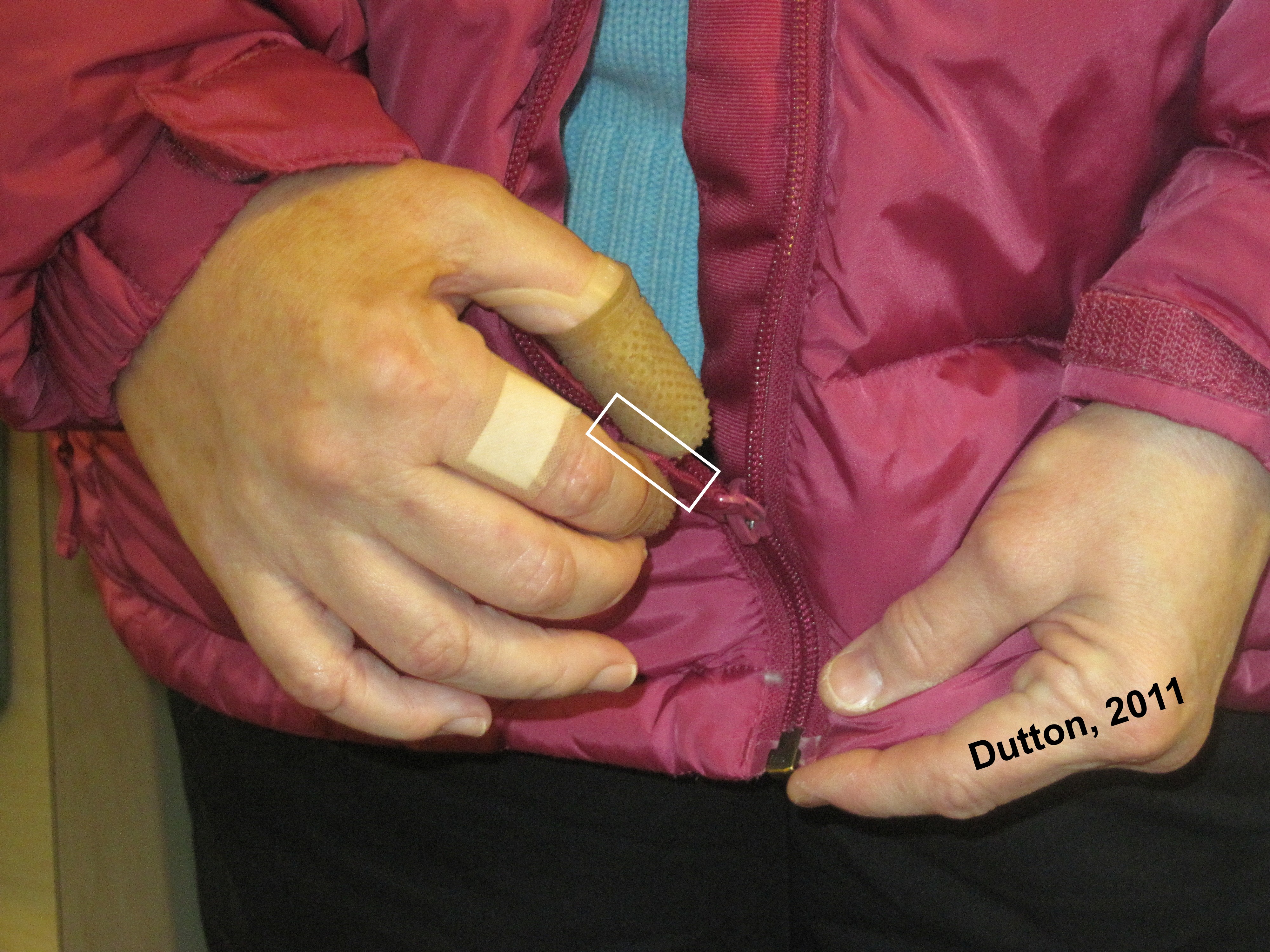
Velcro tabs do not keep me warm.  When I sit in the car, gaps form between the Velcro tabs which lets body heat escape.  Connecting the two halves of the zipper are relatively easy.  My right affected hand only needs a gross grasp to hold the female end of the zipper still while my left sound hand inserts the male end in its slot.                                                                            Challenge #1.  Zipper teeth do not mesh together if they are not perfectly aligned.  Only my sound hand can keep the two sides of the zipper perfectly aligned after they are joined so I can zip my coat  (see next 2 photos). 
Arrows show my sound index finger pushing up on the bottom of my coat to keep the zipper joined.  My sound thumb and middle finger pinch the bottom of the coat to hold it still as I  zip.  My affected hand pulls on the fabric zipper tab (white rectangle).     

After I broke my forearm I lost the tip pinch needed to grasp the fabric tab on the end of the zipper.  I attached one end of a tiny carabiner in the hole of the metal zipper tab (S-biner, size 2 from Home Depot).          I insert my hemiplegic index finger in the other hole of the carabiner and pull the zipper up a few inches.  The top photo shows my current coat has a zipper ring so I no longer need a carabiner.

Challenge #2.  My affected hand can pull the zipper tab up only two inches.  Going higher forces my wrist to bend due to the flexion synergy.  After two inches I switch hand positions.  My affected palm presses against my stomach to keep the bottom of the coat still while my sound hand finishes the zipping.  I unhook the carabiner and put it in my coat pocket so it is not visible at front of my neck.  homeafterstroke.blogspot.com

February 25, 2021

Snow Shoes for a Stroke Survivor

Since my stroke I am careful about venturing outside when it snows, but I am not trapped inside until spring.  Once streets are plowed and sidewalks shoveled, I wear boots over my shoes to give me better traction when icy slush is left behind.  Boots also help when my car is covered with snow.  Dragging snow off my car dumps snow on my boots instead of my shoes.  Boots I tried on at a shoe store would not fit over my leg brace.  My leg brace does not allow me to point my toes which is a pre-requisite for donning boots.  On-line I found the Neos overshoe with a Velvro opening that goes all the way down to my toes.  The Villager model is lightweight and designed for occasional use which is perfect for me.  I walk more slowly with boots on, but that beats not being able to get to the grocery store or keep important appointments, like a doctor appointment.
Notes-to-Self.  1) Make the ankle straps long BEFORE I take the boots off.  Long straps make it easier to unsnap and snap the plastic buckles. After snapping the buckle closed, pull the end of the strap to make it tight.  2) Begin by opening the boot ALL the way to the toe so I will not have to wrestle with the nylon fabric to get my toe in the boot. 

A video at www.overshoesonline.com shows how to don this boot.
Warning #1: I do not put the boots on while standing as the video shows because I do not have good standing balance.  My boots go on safely while I am sitting.  Warning #2: The first set of boots I ordered was too big so they flopped around when I walked.   homeafterstroke.blogspot.com

February 18, 2021

Donning Socks Can Make You Crazy

At 58 years old I wanted to go home instead of going to a long-term care facility.  I live alone so I was motivated to learn how to don socks with one hand.  When Joyce complained about getting her sock crooked in The Tales of a Stroke Patient I understood her dilemma.  She reminded me of the tortuous process I use to do this task.  Pulling a sock up one-handed requires me to pull one side up, then the other side, repeat, repeat, and repeat.  However, holding my leg completely still in the air for that long a time is impossible.


I bend my knee to pull my leg up on the bed to keep it still and avoid leaning over to reach my toes.  My repeated pulling is not always symmetrical so I watch to see if my sock is twisting.
To prevent the heel from ending up on the side of my foot, I go back down to straighten the toe if needed.  When the toe is straight, the heel of the sock ends up on the heel of my foot.  homeafterstroke.blogspot.com

December 28, 2020

My Pain Got worse

My central pain became intolerable at night.  Central pain is constant pain created by brain damage.  Symptoms include pain caused by normally non-painful stimuli, constant burning, 
electric shock-like pain, and a stinging, tingling, or pins-and-needles sensation.  These abnormal sensations are usually localized to one body part, especially the hands or feet.  I have a constant burning sensation in my hemiplegic foot.  Three strategies give me relief.


Initially (1) taking Tylenol and (2) raising the sheet off of my foot helped me fall asleep.  In the photo I placed a ball outside the covers to show you what the ball under the covers looks like.  The ball keeps the covers off the end of my big toe all night long.  When these two strategies were not enough to help me fall sleep I added a 3rd strategy.
(3) Gel packs heated in a microwave oven.  WARNING: Gel packs heat up very quickly and are deceivingly cool at 1st touch.  I heat the gel pack for only 25 seconds on High because a stroke took away my ability to tell the difference between hot and cold in my leg. To safely remove the gel pack from the microwave and transport it to my bedroom, I put it on a stiff paper plate.  I place the gel pack NEXT to my foot. The gentle heat gradually extinguishes the burning sensation in my foot so I can fall asleep.

 Two sensations can cancel each other out.  This is why you rub a painful body part that has bumped into an object.  Ben Gay cream works because it has Capsaicin that produces a mild burning sensation that cancels the awareness of muscle pain.  homeafterstroke.blogspot.com

August 4, 2020

Some People Invade My Personal Space

I snapped at a dear friend when she offered to retie my loose shoelace.  Even though I said I could do it, she insisted on helping.  This made me angry because every doctor I have seen since my stroke reaches down to untie my shoes during a physical exam.  They do it quickly because they know it is not appropriate for a male doctor to undress a female patient.  I do not know how old I was when I decided my clothing is a part of my personal space, but it was a long time ago.

Telling my friend I could do it as fast with one hand as she could do it with two hands was not a deterrent.  She said "I could tie your shoe at least once so you won't have to."  My strategy to handle this more gracefully next time will be to say "Can you tie a shoelace that has only one free end?"  homeafterstroke.blogspot.com