Showing posts with label advanced ADLs. Show all posts

August 3, 2022

Staying Out of a Nursing Home

Today I got a splinter in my sound hand as I walked down my front steps while holding onto a wooden railing.  Thank God I know how to remove a splinter one-handed so I do not need live in a nursing home to get nursing care.  My mother removed splinters by picking at the skin over the splinter with the end of a sewing needle.  This was painful and required delicate fingertip pinch.  A stroke took away my ability to grasp a needle between my thumb and index finger.
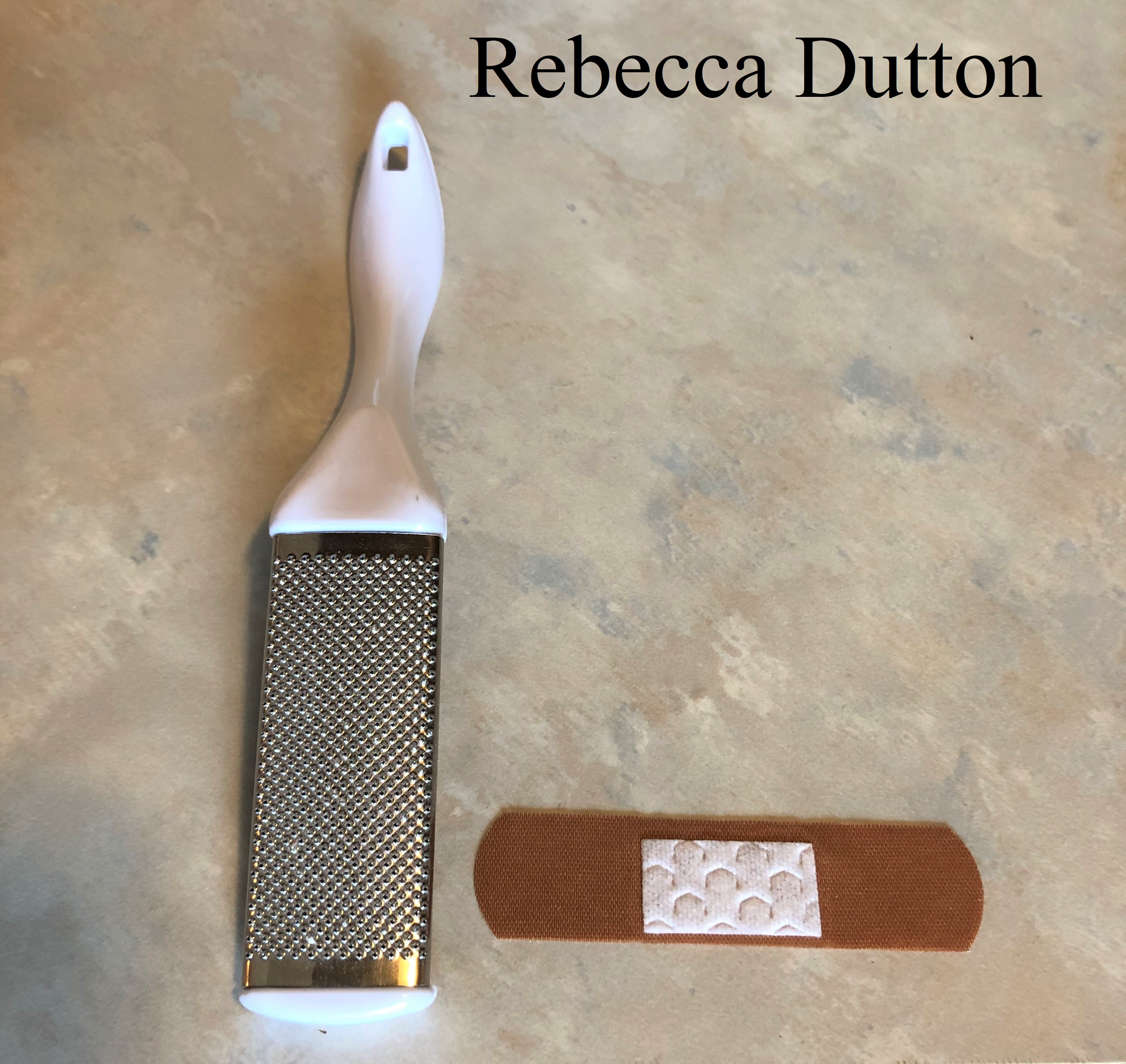
My solution is to use a rasp which removes callouses on the bottom of the feet.  I trap the rasp on a counter with my affected hand.  Then I rake the rasp over the splinter.  I apply gentle pressure and make repeated passes to slowly remove skin.  Today the splinter popped out as soon it was fully exposed.  I followed with Betadine solution.  CAUTION: This method only works for splinters that are close to the surface.

I also know how to put a band aid on my finger one-handed.        I put the band aid close to the edge of a counter.  I put the affected area of my finger on the pad in the center.  Then I roll my finger to the left to get the left side of the band aid to stick to my finger.  Without lifting my hand I roll to the right so the right side of the band aid sticks to my finger.  There is usually a small tail that is not stuck down so I grab it with my teeth and stick it to my finger.  A 2nd reason I do not need to live in a nursing home to get nursing care.  homeafterstroke.blogspot.com

May 4, 2022

Equipment that is WalMart Cheap

As an OT I shopped in expensive medical catalogs.  Now I use a cheap over-the-door plastic hook to hang a terry-cloth bathrobe on a towel bar.  Another plastic hook keeps the head of the shower hose off the floor of my tub when I am finished showering.

If I did not have non-slip shelf liner under the pill container it would start slipping away from me as soon as I reached in to get a pill.  I am glad non-slip shelf liner comes in neutral colors that do not clash with my decor because I have small pieces of it all over my house. 
                                                      homeafterstroke.blogspot.com

April 4, 2022

My Pill Map

I take 10 pills a day so I need a system to make sure I take them correctly.  I am highly motivated because my pills can help prevent another stroke.  For example, taking a baby aspirin every day thins my blood.  Once a week I open all my bottles to put my pills in a 7 day pill box.  Two or three times a year I put 2 tiny pills in one day's compartment but no pill in the next day's compartment.  They are so small they can slip out of my hand without my feeling it.  I catch this mistake with my back-up strategy. 

When I dump the pills I need for the day, the first thing I do is put my 3 bedtime pills in a small blue container.  Fortunately, these 3 pills are oblong and different colors.  Then I put my daytime pills on a hot pad that has a floral pattern and stitched seam lines.  I place each daytime pill in the same position to create a V shape.  If there is a gap in the V shape I know I am missing a pill.  

Fortunately I have excellent pill recognition.  For example,  I know the baby aspirin has rounded edges and tiny letters printed on one side (top arrow).  The medicine I take for my thyroid is also a tiny white pill, but it is completely flat and has a line through the center (bottom arrow).  homeafterstroke.blogspot.com

March 28, 2022

Carts Keep Me and My Stuff Safe

A cart saves me from making numerous turns when I bring home groceries. Food that goes in the refrigerator is scattered in several shopping bags.  I collect cold items on my cart, push the cart to the refrigerator, and stand in front of the open refrigerator - no turning and walking back to collect the next item and then turning to face the refrigerator again.  Turning increases the chance of a fall because it is more difficult than walking in a straight line.


Here I am 3 months after my stroke taking a meal to the table.  When 
I got tired of eating frozen dinners heated in the microwave I started cooking.  Initially I cooked one food, ate it out of the pot, and then cooked the next food.  The day I put three kinds of cooked food on a plate was a triumph.  Now I cook regularly and the cart keeps me from burning my hand while transporting hot food. 


A three-tiered cart allows me to sort my dirty laundry by color while sitting instead of repeatedly leaning over and standing up.  This cart also helps me safely transport dirty clothes to my 1st floor laundry room. 

P.S.  I am sitting on a folding metal chair that is stored behind an open door.  homeafterstroke.blogspot.com 

February 25, 2022

2nd Hardest Challenge to My Independence

Learning to drive a modified car is the hardest task I had to master after my stroke.  The 2nd hardest is dealing with the New Jersey ban on stores providing and selling disposable plastic bags.  Reusable bags sold in stores and on-line are big.  They hold a lot so they are too heavy for me to carry up my front steps.  They also do not nestle together in the rolling cart I use to transport bags from my car to my front door.  Section 1.18 of the law allows customers to use disposable bags so I reuse bags I have saved until they rip.  Going to a long-term facility because I cannot get food in my house is a severe consequence.  Meals-on-Wheels supplies only 2 meals a day Monday to Friday.

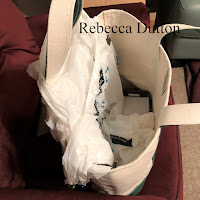
Solution # 1.  I carry my plastic bags in a canvas bag from LL Bean.  The small canvas bag was not tall enough to let the plastic bags hang down fully.  The large canvas bag sags.  The medium canvas bag with short handles is just right (see photo below).

Solution # 2.  I pre-bag a few items like a half gallon of milk and packages of meat that tend to leak.  I bring extra bags to shake open.      I place one handle over the metal arch shown in the photo.  Then I drop the item in the open bag.  This allows me to work at my own pace before I get to the check-out line.

Solution # 3.  When thin plastic bags are nested inside each other, the friction between bags makes several bags pull out at once.  Hanging them side-by-side vertically stops them from sticking together.  However, when I strung the handles of the plastic bags over the handles of the canvas bag it created a messy pile (see left handle).  I had trouble finding a handle that paired with its mate. 


So I weigh down one handle of each plastic bag with a big key ring.  I hang these key rings over the side of the canvas bag where they are easy to grab.  This strategy lets me quickly find one handle so I can pull the bag open, fill it, and lift it out of the canvas bag.


Solution # 4.  Bulky items like a box of cereal and a pack of toilet paper are hard to put in a small plastic bag.  I put a cereal box on the belt last so I can put it in the empty canvas bag which stays open because it is stiff.  For a pack of toilet paper, I make a hole in the top with my car key after I take it off the shelf.  I stick my finger in that hole to put the toilet paper on the belt and in my cart.

P.S.  I am grateful to a kind cashier at Shoprite named Michelle.  When no one was behind me in line Michelle waited patiently while I made numerous mistakes during multiple shopping trips.    The ban begins on May 4th.  I am glad I had all of February to find the solutions listed above.  Rehearsal saved me again.  homeafterstroke.blogspot.com
September 27, 2021

Organizing My Purse is a Vital Shopping Strategy

Trying to find something in my purse by digging around with one hand is awful.  Organizing my purse reduces frustration when I go shopping.  Every woman organizes her purse differently so my examples are intended to help stroke survivors realize a purse does not have to be a buzz kill.

I put my car key on a green wrist coil to make it easy to retrieve.  I grab the wrist coil instead of searching for the key.  I made the mistake of setting the key down to pick up an object on my car seat and then locking and shutting the door.  Seeing my car key on the dashboard was awful.  The AAA car service unlocked my car after I waited for an hour.  When I made this mistake a 2nd time I knew I needed the sensory cue of the coil around my wrist to tell me I have my car key before I get out of my car.                                                                                                My house key is on a straight flexible coil that is hooked on my purse.  All I have to do is pull on the coil to make my house key slip out my purse.   

I can handle credit cards quickly because I keep them in a zippered compartment that holds only a driver's license, one credit card, an ATM card, and a library card.  While sitting in the parking lot I place the card I need vertically so it stands out from the other cards which are horizontal.  Cards go back in this zippered compartment in a flash.  Less frequently used cards like my health insurance card are in another compartment.    homeafterstroke.blogspot.com

August 28, 2021

ADLs Are Where the Repetitions Are

Brain plasticity is amazing, but rewiring the brain requires thousands of repetitions.   Activities of Daily Living (ADLs) are a great way to get those reps. The examples below show why three sets of ten each day cannot compete with ADLs.

1) Twice a day I open my affected hand to grasp a tube of toothpaste so my sound hand can remove the cap.  My affected hand opens again to hold the tube while my sound hand puts the cap back on.  In nine years I have opened my hand over 5000 times before brushing my teeth.


2)  Shopping is therapy for my hand.  I open my affected hand to let go of the cart to reach for items with my sound hand.  My affected  hand opens a 2nd time when I grab the cart to move on. My affected hand opens a 3rd time so I can empty the cart in the check-out lane and again to load food into my car.  Pick uping 30 items + empty cart + load car means I open my hand 60 + 2 + 2 = 64 times.  64 x 2 visits a week x 9 years means I have opened my hemiplegic hand 59,904 times in the grocery store.

3)  The distance I have walked at the grocery store is huge.  I step away from the shopping cart and bend down or reach up to get items I want.  The curves I make to detour around people and other carts require more steps than walking in a straight line.  According to my pedometer I walk 2,000+ steps each time I visit the grocery store.  2,000 x 2 visits a week x nine years = 1,872,000 steps!
homeafterstroke.blogspot.com

July 3, 2021

Staying Safe When I Do Laundry

I do laundry with the help of 2 cheap pieces of equipment I bought at Walmart.  My washing machine is so deep that to reach all the clean clothes, I have to dive into the machine with my hips resting on the rim and my feet dangling in the air.  So I use tongs designed to handle food to reach the bottom while I keep my feet on the floor.  To keep frustration from ruining my success, I keep these tongs in the laundry room where I can grab them without hunting for them.


My dryer is so deep I have to lean down and stick my head in the dryer to reach all the dry clothes.  To prevent a fall I put a cheap folding metal chair in front of the dryer.  Sitting an a chair when I reach for clothes in the back eliminates a fall hazard.  I keep this chair folded and propped against the laundry wall.  

I try not to feel smug because I did not buy high-priced adaptive equipment from a medical catalogue.  homeafterstroke.blogspot.com

Teach Us to Turn in the Kitchen

Having PTs walk me in straight lines in the PT gym and walk around the block after I went home did not prepare me for the problem solving I need do while walking.  In the hospital I was in a wheelchair, but after I got home I had to teach myself to safely turn 180 degrees while standing with the support of a cane to shut the bathroom door and turn again to flush the toilet.  

Here is another example.  The photo shows the turns I take to prepare a glass of iced tea and a bowl of cereal with a sliced banana for breakfast.  Turning away from a counter is a fall hazard because it is done by stepping backwards.  I have impaired balance so my inner ear does not tell me how far away from vertical I have stepped.  After I fell and broke my forearm while turning I got scared.  Now I use itsy bitsy baby steps to backup and turn before taking normal size steps in the new forward direction.


Research on this topic is emerging.  Chen trained stroke survivors on a straight OR a turning-based treadmill (1). Subjects walked on a round treadmill that turned underneath them as they walked in one place while holding onto parallel bars.  Subjects who learned to to accommodate the constant change created by the round treadmill were significantly better at turning while walking on level ground.  Not being able to sahomeafterstroke.blogspot.comfely turn while being distracted by a purposeful activity has serious implications. 

1. Chen, I, Yang, Y, Chan, R, Wang, R. Turning-based treadmill training improves turning
    performance and gait symmetry after stroke. Neurorehabilitation and Neural Repair. 2014;28
    (1):45-55.

June 28, 2021

The Gift That Keeps on Giving

In the hospital my PT had me reach down with my sound hand to pick up cones sitting on a stool and stand up to place the cones on a shelf at head height.  I saw the value of this exercise when I started to wobble less as I reached down to pull up my pants at the toilet. I could not go home if I needed 24 hour assistance for toileting.  When Michelle did not have me squat in the morning,
I asked to do it in the afternoon.  After I went home activity analysis helped me identify how squatting keeps me safe during dozens of tasks.  Activity analysis is the gift that keeps on giving because it tells me WHY I WORKED SO HARD.

   I bend my knees and hips when I reach down to:
* Pull up my underwear and pants after toileting
* Pick up my cane after it has fallen on the floor for the thousandth time
* Get clothing out of the bottom drawer of the dresser
* Get shoes from the floor of the closet
* Get a milk carton sitting on the bottom shelf of the refrigerator
* Get a box of cereal from the bottom shelf of a kitchen cabinet
* Get a heavy pot from the bottom shelf of a kitchen cabinet
* Get a box of dishwasher detergent from under the sink
* Take a heavy book from bottom shelf of book case
* Plug a cord into a low electrical outlet 
* Pull clothes out of the dryer
* Use a garden hose to fill a watering can that is sitting on the ground
* Empty a waste basket
* Pickup a bag of garbage to take it to the outdoor garbage can
* Pick up purchases sitting on the floor of my car

P.S. Reaching down by bending at the waist with straight legs is hard on my arthritic low back.
homeafterstroke.blogspot.com

June 20, 2021

Task Modification Never Ends

A stroke can make you stop trying when you cannot finish what you started.  For example, curbside delivery at the library is great.  I select a pick-up time on-line and a staff member brings the books out to my car.  However, I am frustrated when I get the books home.  Transporting heavy or multiple books from my car to the house with a plastic shopping bag is difficult.  The bag slips down my forearm to my wrist and falls to the ground.  I tried tucking the books in my affected armpit, squeezing them close to my chest, and walking very slowly to my front steps.  This was a nerve racking trip.

Thankfully an L.L. Bean canvas tote came to my rescue.  The stiff
canvas handles stay flat and separated.  This allows me to grab one handle to keep the tote from slipping off my forarm as I walk.  Success every time is great!    homeafterstroke.blogspot.com

June 16, 2021

Qualifying for Disability Benefits

I was surprised to learn that having a stroke was not enough to establish my need for paratransit.  When I had an interview with paratransit services they asked me to give examples of why I could not take a regular bus.  My sound hand has to manage a cane and my hemiplegic hand cannot insert money in the fare box.  If I do not sit down quickly, the lurching movement of the bus would make me fall because I have poor balance.

Approval for social security disability (SSD) also required explaining how specific deficits interfered with my ability to do specific job related tasks.  Being one-handed meant I could not demonstrate or help OT students perform bimanual therapeutic techniques.  The physiatrist who filled out his section of the SSD application form was able to document my inability to perform functional tasks because he heard therapists talk about me in team meetings.  Neurologists do not evaluate or document the loss of independence that is needed to qualify for disability benefits.  homeafterstroke.blogspot.com

February 4, 2021

On-line Grocery Shopping

Janet is a dear friend who can speak truth with kindness.  She gently talked me into paying a grocery store employee to shop for me during the winter.  Thanks to Janet, I did not become hysterical about being stuck in my house with no grocercies because of a blizzard.  When weather reports became dire, I ordered groceries on-line and picked them up before the snow storm hit.  This photo shows I was right to worry.

The designated parking spaces I have to use for on-line grocery shopping are too narrow for me to put a shopping cart next to my car to unload groceries.  So I put groceries in my trunk.  I am glad I put boxes and a cooler in my trunk before my 1st attempt.  I do not want to use my cane to fish around for cans and round produce that could roll to the back of my trunk.  homeafterstroke.blogspot.com

January 28, 2021

Community Ambulation Falls Thru the Cracks

Stroke survivors have to figure out how to walk safely in the community.  Walking in PT gyms and on deserted sidewalks in my neighborhood did not prepare me for walking in community settings.  
I had to teach myself how to maneuver around carts and people in a grocery store, squeeze past closely placed chairs and tables in a restaurant, and deal with children in a shopping mall who do not look where they are going.  PTs do not know walking requires divided attention because they walk clients in wide empty spaces that provide no cognitive challenges.  Equally unfortunate, OTs who are trained to address cognitive issues do not assess community ambulation because walking is PTs domain.  So community ambulation falls through the cracks. homeafterstroke.blogspot.com

January 19, 2021

Staying in My Home is Not Easy

The independent living facility I hope to go to has a heated underground garage.  Until I move, I need 5 snow strategies because I have to park my car on the street.  When snow is forecast my 1st strategy is to go grocery shopping.  When we get a dusting of snow I use my 2nd strategy.  I use a child-size shovel to push snow onto my lawn.  I sprinkle Ice Melt on my walkway and in front of my car.  The big container is heavy so I use a funnel to pour Ice Melt into a small container sitting in my bathroom sink.  My sound hand lifts the big container.  My affected forearm under the big container controls the degree of tilt.  

New Jersey often gets above freezing after a snow storm.  When the weather forecast says this will happen I use my 3rd strategy.  I wait a few days for the sun to free my snow-covered car.  However, the street has a low spot that captures water as the sun melts the snow.  I need a 4th strategy to cross this small pond.  I place a thick rubber matt over the water so I can to get to my car safely.  

When the weather forecast says New Jersey will stay below freezing after a snow storm I use my 5th strategy.  I pay two teenage boys to clean my car, walkway, and snow that the snowplow has pushed against the side of my car.  They also shovel snow in front of and behind my car so I have a clean parking space.  Old people in my neighborhood are nasty when someone takes the parking space in front of their house.  homeafterstroke.blogspot.com

December 12, 2020

Opening Cans With One Hand

I do not use lots of canned food because most are heavily salted.  However, I love to make homemade spaghetti sauce and chili which require some canned food.  I make a big batch and freeze it in individual food containers that can be heated in the microwave.  Since I cannot make food taste better with butter or cream sauces I add lots of veggies to these one pot recipes.

I use an electric can opener made by Krups that uncrimps the metal rather than cutting it.  This leaves a smooth edge so the top can be put back on if you want to use the contents later.  The photo on the right shows how a right-handed person holds it while the photo below shows how my left hand holds it so I can see what I am doing.

Short cans do not have the clearance I need so I put them on a food storage container.  Since I do not open cans that often I have trouble finding the exact angle the opener requires.  I have to try two to three times before my wrist remembers the correct angle.          I know when I get it right because the noise changes from a high pitched whine to a low pitched growl.  The only time this can opener has let me down is when a hurricane has cut my electricity.

October 26, 2020

Paratransit Skills

An article about community mobility skills (1) reminded me that OTs do not know if clients can use paratransit without knowing the demands of the systems available to them.  Here is a comparison of two systems I used.  One covers the state of New Jersey.  The other covers only my county.    

Language.  To qualify for the county service I only had to give my address and diagnosis during a brief phone conversation.  The state required a one hour in-person interview where I had to give specific examples to explain why I could not take public transportation.  Giving my diagnosis was not enough.  When making a reservation, both systems asked me what ambulatory device I used (e.g. cane, wheelchair) so they knew what type of vehicle to send.

Balance.  My balance is poor so I would fall if I was standing when the vehicle started moving.  Both services did not allow the drivers to start driving until I was seated and had my seat belt fastened.  Vehicles that carried wheelchairs had tie-downs which the drivers handled. 

Strength.  The county provides door-to-door service which means the driver provides physical assistance to go up and down stairs and carry packages.  The state provides curb-to-curb service.  This meant the driver stood by the vehicle while I got myself in and out of the house, on and off the vehicle, and transported packages.  Both services had vehicles with a wheelchair lift to get a client in and out of the vehicle.

Endurance.  I had to wait for the county service to pick up a few seniors that wanted to go to the senior center.  I had a short 2 mile ride with the seniors before I was dropped off at the grocery store.  The state service picked me up from 20 minutes before to 20 minutes after the time I requested (a 40 minute window).  The state may run long trips with multiple riders who have different destinations.  When I had to wait for other people to be picked up and dropped off, I might ride for an hour before reaching my destination.  With both services I had to be at the door so I could see the vehicle pull up which would wait only 5 minutes.  I bought a folding three-legged stool with a shoulder strap that hunters use so I could sit down if I got too tired in a store.  

Planning Ahead.  For the county a reservation had to be made 2 weeks in advance and they asked only for my name because they took me to only one destination.  For the state a reservation could be made 24 hours in advance and they asked for my paratransit identification number.  To remember the pick-up times at each end of my trip I wrote them on a calendar for the day of the trip.  The county service required only the name of the store because the person making the reservation was local and knew the area.  The state service required exact addresses and names of cross streets because the person making the reservation was miles away.  I got out a list of this detailed destination information before making a reservation.  Both services had a two bag limit.  This meant I had to plan multiple trips when I needed bulky objects like toilet paper.  I also had to plan repeated trips because paratransit took me to only one destination at a time - grocery store, drug store, doctor, dentist, out-patient therapy, etc.

Money Management.  The county service was free.  The state service required exact change.  They told me the cost of a one-way fare when I made a reservation.  Cost was based on what it would cost me to make that trip on public transportation (e.g. bus fare of $2.25).  I kept a supply of one dollar bills and coins.  homeafterstroke.blogspot.com

1. Dickerson A, Davis E.  Ckecklist of community mobility skills. OT Practice. 2020;October:13-16.

September 3, 2020

Cheap Equipment That Reduces Frustration

A cheap seam ripper I bought at a sewing goods store got rid of a ton of frustration.  I open seals around the top of bottles by slipping the point of the seam ripper under the edge and ripping upwards or downwards.  Then I pull off the seal by grabbing the cut edge with my sound hand while I squeeze the bottle between my thighs.  Sometimes I grab the cut edge with my teeth as my sound hand holds the bottle.  No more trying to slice with the tip of a knife which shreds rather that cuts.  


I use the tip of the seam ripper to rip open the foil at the top of a pill bottle and dig out the cotton ball that fill half of the bottle.  Preventing decades of frustration is not a small thing - so much energy saved for better things. homeafterstroke.blogspot.com

August 4, 2020

Writing Aids I Cannot Live Without

The long boring weekends in the rehab hospital drove me crazy.  When my recreational therapist gave me an opportunity to practice writing with my sound, non-dominant left hand I jumped at her offer.  My friend Arlene did not volunteer to write checks to pay my bills for the rest of her life.  Kathy helped by bringing me clear Dycem and crossword puzzles she had enlarged on a Xerox machine to make the spaces bigger.  Clear Dycem is thin and slightly sticky so it holds the paper still as I write.  Solving crossword puzzles was more fun than writing letters of the alphabet over and over like I did as a young child in school.

When I got home I found clear Dycem at www.pattersonmedical.com but was shocked at the price.   However, I splurge on a small roll of clear Dycem which costs $55 + shipping and handling because it is a writing aid I cannot live without.  I have pieces of it every where I sit down to take phone messages, pay bills, do crossword puzzles, write reminders on Post-It Notes, etc.  I make it last longer by washing it.  A small roll (8 inches x 2 yards) lasts almost two years. 

I also splurge on gel pens that cost $15 a box.  Gel pens are more forgiving that ball point pens that must be held at a precise angle to make the ink flow.  homeafterstroke.blogspot.com 

July 10, 2020

I Cannot Use Salt to Make Food Tasty

I had a 2nd stroke two years after my 1st stroke so I got serious about lowering my blood pressure with a low salt diet.  Low salt food tastes terrible so I jacked up the flavor with onions and garlic.  Peeling garlic is a challenge.  I use the smooth side of meat pounder to smash the garlic open so I can remove the peel with my sound hand.  Then I chop the garlic with a large kitchen knife. Rocking the knife over the garlic creates a mix of small and medium size pieces.  I place a food scraper in my affected hand so my sound hand can scoop up chopped food and dump it in a mixing bowl or pot.  Notice that the fingertips of my affected hand are not touching each other or the food scraper.

But sometimes I want small uniform pieces of garlic that are evenly distributed in a dish.  I spice up turkey burgers by stirring crushed garlic into an egg before adding it to the raw meat so I will not bite into a big hunk of garlic.  However, a garlic crusher takes lots of hand strength to squeeze the two arms of the crusher together.

I rest the bottom arm of the crusher on my cart as I grasp it with my sound hand.  Leaning on the top arm lets me press down with my whole arm.  I catch pieces of flying garlic with a piece of saran wrap.  To get garlic clinging to the crusher into a bowl or pan, I place the crusher in my affected hand so my sound hand can use a knife to scrape off the garlic.  homeafterstroke.blogspot.com