Showing posts with label cognition. Show all posts

May 18, 2021

Walking in a Barren Environment

Walking in wide, empty spaces did not prepare me for tasks that force me to stop concentrating fiercely on my hemiplegic leg while I am walking.  In-patient PTs walked me in gyms with equipment and people sitting around the periphery.  When two clients who are walking approach each other the PTs look at each other and decide who will stand still while the other person moves first.  Home health PTs walked me around the block in the middle of the day when nobody was outside.  PTs work in a barren environment that does not make them aware of cognitive demands.

Stroke survivors need to walk sideways between tables at a restaurant and go down stairs that have a railing only on their affected side.  At a store - walk in circles around racks of clothing and stop for people who are not watching where they are going.  At a hair salon - sit down in the chair without tripping over the big metal footrest.  Using a public toilet - turn around to sit on the toilet regardless of which side the grab bar is on.   Clients and family members need to understand that walking requires problem solving as well as physical mobility.  

Football coaches do more than have players throw and catch footballs and do foot agility drills.  Football players eventually have to stop concentrating on their body and start thinking about their opponents' strategy as they move.  Athletes and musicians have rehearsals to make the transition from practice to function.  Why are stroke survivors not getting the same kind of help?  homeafterstroke.blogspot.com

March 3, 2021

How I Feel Less Guilty About Asking For Help

I live alone so I am both a stroke survivor and a caregiver.   I use 7 strategies to keep my volunteers from burning out (18 years) and feel less guilty about asking for help.

1. Prioritize.  I cut down the number of requests by identifying what I need versus what I want.  I need someone to get on a ladder to change the batteries in my smoke detectors.

2. Build trust.  People do not need special training to know they are being taken advantage of.  When I ask for help I let my volunteers know I do everything I can before I contact them.  People feel good about helping when they know they are really needed.  This strategy builds trust.

3. My husband would groan rule.  I cannot ask people to do things that would make a husband groan.  I cannot ask someone to buy a live tree, transport it, drag it into my house, use an ax to trim the base so the tree fits in the stand, and tighten and loosen the tree stand to reposition the tree until it is straight.  So I bought an artificial tree.  John takes it out of the box and snaps the four pieces together.

4. Let them choose WHAT to volunteer for.  I e-mail a request and let people choose things they want to do.  Peggy who loves to sews repaired the sleeve on my raincoat.  Barbara who is a computer technician volunteered to help me set up the router for my internet service.  Letting people choose what to do means I do not risk rejection because I have asked the wrong person.

5. Let them choose WHEN to volunteer.  After they volunteer I ask them when would be a good time for them.  Everyone has busy lives so it is less of a burden when I fit into their schedule.

6. Make a list and stick to it.  Before someone comes I make a list of the things I need done so my volunteer knows when he or she is done.  I stick to the list instead of looking around and saying "there is one more thing I need you to do."  This list also reminds me to get materials my volunteers need.  Before John comes to replace the batteries in my smoke detectors I buy 9-volt batteries.

7. 80% rule.  The 80% rule means some things can be mostly correct rather than perfect.  After my stroke I gave myself permission to not make everything perfect.  For example, the seam of my bedspread is supposed to be where the edge of the mattress is (see the black line).
It is only fair to extend the 80% rule to my volunteers.  Nobody wants to hear that they did not do it the way I used to do it.
homeafterstroke.blogspot.com

January 19, 2021

Staying in My Home is Not Easy

The independent living facility I hope to go to has a heated underground garage.  Until I move, I need 5 snow strategies because I have to park my car on the street.  When snow is forecast my 1st strategy is to go grocery shopping.  When we get a dusting of snow I use my 2nd strategy.  I use a child-size shovel to push snow onto my lawn.  I sprinkle Ice Melt on my walkway and in front of my car.  The big container is heavy so I use a funnel to pour Ice Melt into a small container sitting in my bathroom sink.  My sound hand lifts the big container.  My affected forearm under the big container controls the degree of tilt.  

New Jersey often gets above freezing after a snow storm.  When the weather forecast says this will happen I use my 3rd strategy.  I wait a few days for the sun to free my snow-covered car.  However, the street has a low spot that captures water as the sun melts the snow.  I need a 4th strategy to cross this small pond.  I place a thick rubber matt over the water so I can to get to my car safely.  

When the weather forecast says New Jersey will stay below freezing after a snow storm I use my 5th strategy.  I pay two teenage boys to clean my car, walkway, and snow that the snowplow has pushed against the side of my car.  They also shovel snow in front of and behind my car so I have a clean parking space.  Old people in my neighborhood are nasty when someone takes the parking space in front of their house.  homeafterstroke.blogspot.com

November 28, 2020

Fatigue is a Deal Breaker

The fatigue I felt for the first year after my stroke was unlike anything I had ever experienced.  
I repeatedly felt a crushing fatigue that I could not push through.  When I did not rest, I could barely hold my head up after dinner.  Using a timer to force myself to rest was annoying because it would go off at the worst time.  Watching TV turned me into a zombie who could not stop clicking the remote because nothing good was on at the moment.  I tried reading and going on the Internet, but I got so absorbed in these activities that sitting for long periods made me tired.  I found two strategies that work for me. 

(1) Brief rests before the fatigue overwhelms me.  Lying on top of the bedspread with a towel under my shoes does not feel like I am going back to bed.  I lie down for fifteen minutes without having to get undressed.  (2)  Energy conservation.  For example, I divided doing dishes into 3 steps.  
Step 1: Empty dishwasher - rest 5 minutes.  Step 2: Take clean dishes to the appropriate cabinet with a cart.  I did not have to repeatedlty carry heavy stacks of dishes from the dishwasher to each cabinet - rest 5 minutes.  Step 3: Load dishwasher.  I have a double sink so I use one sink as a staging area to hold dirty dishes until I need to wash them.    

GOOD NEWS: My crushing fatigue faded after the first year!    homeafterstroke.blogspot.com

November 10, 2020

The Only Magic Bullet I Have Found

Sometimes stroke survivors tune people out, but not necessarily for the reason you think.  When I am struggling with a task, I start talking to myself.  For example, when I heard my toe scuffing the floor because I did not lift my leg high enough in the 1st year I silently said "knee up, knee up."  If someone was talking to me at that moment I did not hear what that person said.  I cannot listen to other people when I am talking to myself.  If you want me to process new information or I want to participate in a discussion, I need to sit down.
 
Avoiding multitasking is a magic bullet because it has an immediate effect.  By not dividing my attention, I  focus all my energy on the part of my brain I need to use right now.  When I take a hot dish out of the the oven I stop talking to guests.  I need to monitor my hemiplegic hand to make sure it maintains a firm grip on the 400 degree handle.  When I drive during rush hour I turn off the radio.  I need to respond quickly to aggressive, unpredictable, impatient drivers.

I am not saying stroke survivors can never multitask.  However, it can take many repetitions before a task becomes so automatic that I can simultaneously pay attention to a second task. 
homeafterstroke.blogspot.com
June 4, 2020

Do Not Go Gently Into That Good Night

An OT told me about a client in a nursing home who wanted to get off the toilet line.  The toilet line is for people who have to wait for two aides to transfer them on and off the toilet.  The client wanted to get off the toilet line so badly it took her only 2 months to learn how to use her artificial leg again so she could walk into the bathroom.  This story confirms my worst fears about nursing homes.        I can hear the staff telling this woman she would feel much safer in a wheelchair.  Her story reminded me of Dylan Thomas's poem.

Do not go gently into that good night
Old age should burn and rave at close of day
Rage, rage against the dying of the light

My rage was triggered recently when someone tried to take away my independence.  Women at my breakfast club give small gifts for Christmas.  To make it easier to take the gifts home, I put them in the bag that came with one of the gifts.  The photo shows the hook on the Christmas ornament that kept getting caught on the handle of the bag.  As I was struggling I saw a hand reach across the table.  The hand disappeared when the rage I felt showed on my face.  I should have said "I'm not a young child playing with a sharp knife" so say "may I help you?' homeafterstroke.blogspot.com

May 2, 2020

Another Cheap Solution

Here is another example of how stroke survivors can use cheap every day items to solve problens instead of ordering equipment from an expensive medical catalogue. I love my kitchen garbage can except for 1 thing.   As it gets full, the weight of the garbage pulls the liner down.  The notch (see arrow) does not keep the liner in place.  Garbage can get caught between the liner and the can - yuk. 

Recently I saw 2 metal clips resting on my counter that I forgot to put away.  I thought the clips might hold the liner in place.  Voila - the tiny black clips next to the hinge do the job.  I am so happy.  Serendipity saved me again.  Having a master's degree in OT is not enough.

I had to do in-store shopping to find a kitchen garbage can I can use.  I discovered I cannot use a garbage can that opens by stepping on a pedal.  This mechanism requires me to slowly step on the pedal so the lid does not fly open.  My balance is not good enough to do this.  I learned garbage cans with openings in the lid that swing open when touched are small so the edges can get spattered with food - another yuk.

A model made by Hefty has a lid that hangs over the side (see arrows).  I lift the lid with the back of my hemiplegic fist so my sound hand is free to dump the garbage.  homeafterstroke.blogspot.com

February 3, 2020

I Am the Queen of Velcro

I buy self-sticking Velcro because is makes me independent and safe.  

I use Velcro to stop a tote bag from banging against my cane when I walk.  The white line shows where the two pieces of Vecro connect.


It is easy for objects to fall out of my tiny purse.  It has a 2 piece latch (see horizontal black line) that is hard to snap together with one hand.  So I put Velcro on my wallet and inside my purse. 


The Velcro adhesive is NOT strong enough to stay fastened to my wallet when I pull it away from the Velcro inside my purse.  So I stapled the Velcro to the wallet.  


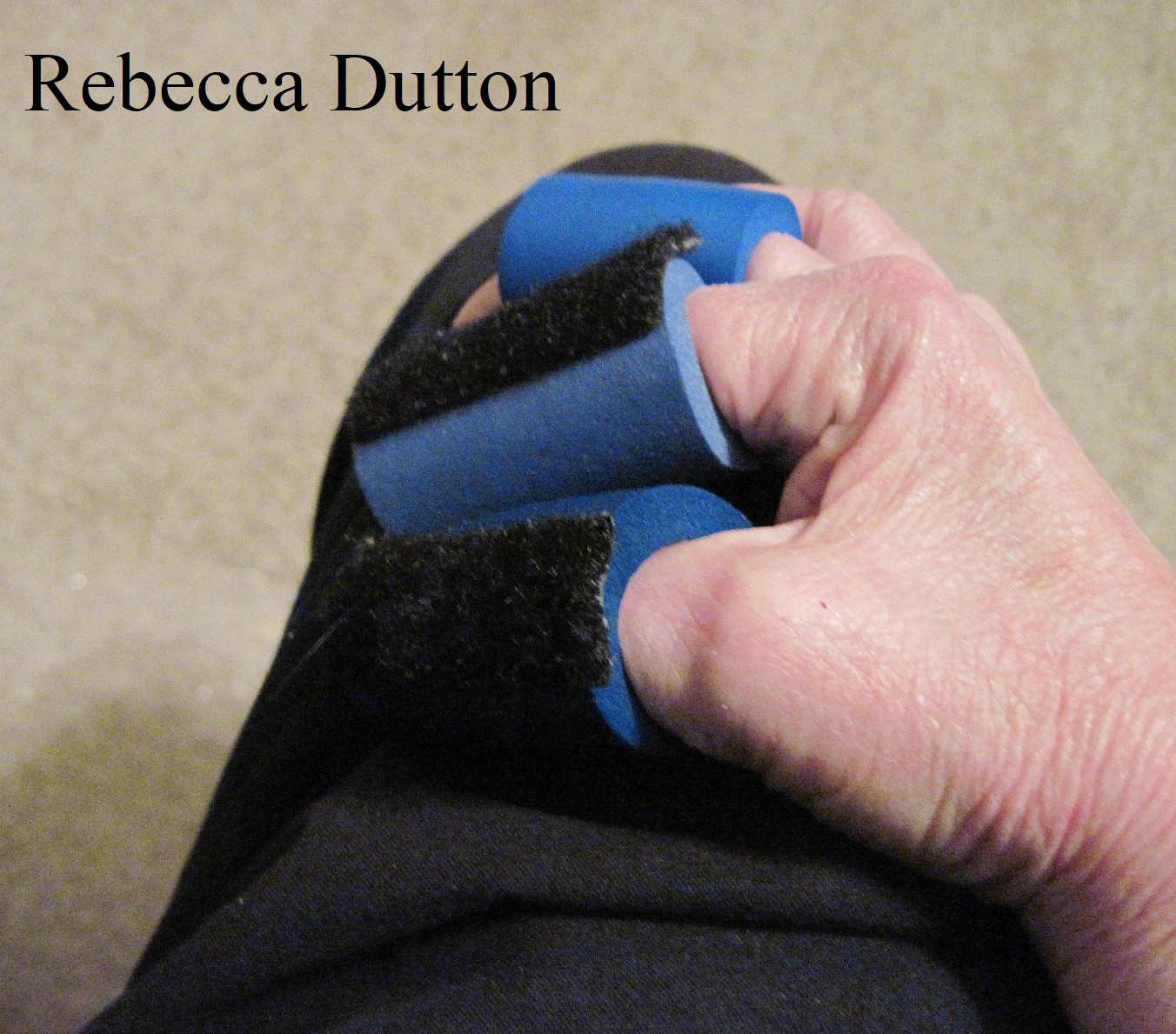
I put Velcro on foam tubing used to make the handle of a spoon and fork bigger.  Velcro sticks the foam tubing to the shelf that holds my computer keyboard.  This keeps my hemiplegic fist uncurled.  


A computer technician used white tape to stop my USB hub from sliding when I push a thumb drive into a port.  However, the tape covers 2 ports so I cannot use them.  I had a friend put 2 strips of Velcro on my computer desk and 2 strips on the bottom of the USB hub.  homeafterstroke.blogspot.com