May 9, 2021

Rolling Over in Bed Can Be a *****

Right after my stroke, rolling over in bed took horrendous effort when I was most tired.  When I rolled onto my sound side, my floppy hemiplegic arm would get stuck behind me.  It felt like a wrestler was pinning my upper body to the bed.  I had to remember to use my sound hand to pull my hemiplegic arm across my chest before I started to roll while pulling on the bed rail.

Seventeen years later rolling onto my sound side is still difficult.  One night when I wanted to roll over so I could sleep on my sound left side, my hand reached for the folding chair I placed next to my bed.  This chair is lower than my bed which makes it easier to lean down to tie my shoes.  With the help of the chair and a hemiplegic arm that now rolls with the rest of my body, I quickly fell asleep.  Once again serendipity made my life better.   


However, I have gotten good at rolling onto my hemiplegic right side to get out of bed.  My sound arm crosses over my chest as I swing my sound leg over my hemiplegic leg.  My sound hand reaches for the mattress as I hang both legs over the edge of the bed.  The weight of my legs dropping down helps pull my trunk and head up.  My sound hand pushes on the mattress to help me sit up.  homeafterstroke.blogspot.com

May 4, 2021

The Whacky Grasp That has No Name

My sound hand can place small objects between the index and middle fingers of my affected hand so this hand can hold objects still.  As an OT I know this is a weird grasp that has no name.            As a stroke survivor it makes me really happy.


The index and middle fingers of my affected hand can hold a toothbrush so my sound hand can squeeze toothpaste on the brush.  


The index and middle fingers of my affected hand can hold a cotton swab still while my sound hand cuts it in half.  This creates smaller pieces of cotton I put in my ears before I use hair spray on my short hair. 


I use my teeth to pull a rubber glove on my sound hand.  I do not want to touch shopping carts and transfer what my hand picked up to my car key, car door, and steering wheel.  When I get my groceries to my car, I use my teeth to pull the glove off inside out.  I do not want to leave a dirty glove in the cart so I place it between the index and middle fingers of my affected hand.  
I unlock  my car door and put the used glove in a cup in my car.
Then I put my groceries on my back seat.  

homeafterstroke.blogspot.com

April 27, 2021

Saved by the 80% Rule

Ironing aprons after the Spring Sale at my church reminded me of a pleasant childhood memory.  I remembered when my mom taught me to iron by having me iron handkerchiefs.  This was a simple task I did successfully the very first time.  However, it is easier to get wrinkles out of a handkerchief than an apron.  Fortunately these aprons do not have to be ironed perfectly because they will be stacked in a box until next year and will come out a little wrinkled anyway. 

This got me thinking about the 80% rule.  Business managers use the 80% rule to keep down costs.  Some tasks that are 80% correct do not affect the bottom line while others have to be closer to perfect.  The rule says you need to think about striving for perfection because the last 20% requires nearly as many resources as the first 80%.  Business managers are paid to decide when a company should spend extra resources to approach perfection.  I wish I had known about the 80% rule when I was married.  When my husband did not smooth out the bedspread perfectly I would have known  this is an acceptable business practice.

I do not know where I got the idea that ALL work has to be done perfectly ALL the time.  I used to be a perfectionist, but now I think perfection should be a conscious choice rather than a habit.  
I live alone so when I am exhausted or frustrated I use the 80% rule.  homeafterstroke.blogspot.com

April 19, 2021

Arm and Leg Synergies are Different and the Same

The affected arm is dominated by the flexion synergy while the affected leg is dominated by the extension synergy. This means muscles that straighten the knee and point the toes are strong while muscles that bend the hip, knee, and ankle are weak.  I also cannot move a single joint. 

To point my toes I have to straighten my whole leg (photo on left).  To bend my ankle I have to bend my hip and knee (photo on right).  All this unwanted movement is exhausting.
 Problem: My weak hip and knee flexors do not always lift my leg high enough to clear my toes as I take a step.  The extension synergy forces my toes to point.  The photo on the left shows me stubbing my toes.                                                                                                                                                      Solution: I faithfully wear my leg brace because it lifts my toes up which prevents falls.  
Problem: The extension synergy makes my affected knee snap into a fully straightened position every time I take a step.  This abnormal movement will eventually damage my knee.  Muscles on the back of my thigh (see pink line) are too weak to stop my knee from snapping into this dangerous position.

Solution: My leg brace keeps my knee slightly bent (see green line) when I take a step.  I faithfully wear my leg brace because I do not want to have knee surgery.  homeafterstroke.blogspot.com

April 11, 2021

New Strategy for Obnoxious Able-bodied People

While struggling to get my sound arm out of the sleeve of my coat today, I thought about able-bodied people who insist on helping me.  People who grab an object out of my hand make me angry.  The last time I was treated this way I was 18 months old.  Nothing I have said has stopped people who insist they can quickly do what I am trying to do.  They are uncomfortable watching me struggle so they assume I am frustrated.  But struggling gives me confidence.

Let me give you an example.  I have never gone to bed with my coat on because I live alone.  Instead of feeling fear when I walk in my door, I relax because I know repeatedly wiggling my sound arm will get that arm out of its sleeve.  I know this because this strategy has never failed.  The next time an able-bodied person insists on helping me, I am going to tell then they are stealing an opportunity for me to have faith in persistance.  homeafterastroke.blogspot.com

April 4, 2021

More Good and Bad News

The good news is exercise can help stroke survivors regain control of their body.  I have done exercises for 17 years after my stroke.  Pain motivates me to exercise.  When I fell I broke a forearm bone (ulna) near my hemiplegic elbow which caused arthritis.  This produces a sharp pain if I do not stretch.  Before I get out of bed, I repeatedly bend and straighten this elbow and rotate this forearm.  I also have a bad back that creates agony if I do not stretch every day.  I get up in the morning to go to the bathroom and go back to bed to stretch my back while my muscles are still warm.  Skipping 2 days makes me stiff and skipping 3 days produces pain.  

Preventing fatigue also motivates me to exercise.  A stroke can create crushing fatigue that I cannot push through.  After 2 days of walking indoors I feel tired when I walk in the community.      So at the end of each day I write that day's aerobic activity on a monthly calendar I keep on my kitchen table.  At breakfast I can see if I sat at home the day before and plan the current day's aerobic activity.  Examples include Fitbit data when I walk in my neighborhood and shopping that requires me to push a cart and repeatedly lift objects.

The bad news is I can no longer be trusted to do exercises that maintain strength.  1st, gradually losing strength does not raise red flags that compel me to act.  2nd, I have a life so I no longer want to organize my day around home exercises.  However, I repeatedly do a few reps that do not disrupt the activity I am doing.  It is hard to find an excuse for not doing these brief exercises. 

For example, I get up from the computer every 20 minutes to turn off an alarm on my iphone in the kitchen.  This alarm prompts me to do 3 brief exercises.  Before I stand up, I lean down so my hand almost touches the foor and straighten my fingers ONE time.  When I sit back up, I reach back to touch the back of my chair with both forearms ONE time.  This stretches the muscle that pulls my arm across the front of my chest (pec major).  After I go to the kitchen to turn off the iphone alarm, I sit and open my hand THREE times.  

I also open my hand when I sit on my bed to use deoderant.        I open my hand ONCE before I take the cap off the bottle and ONCE after I put the cap back on.

homeafterstroke.blogspot.com

March 3, 2021

The Zipping Challenge is Not What You Think

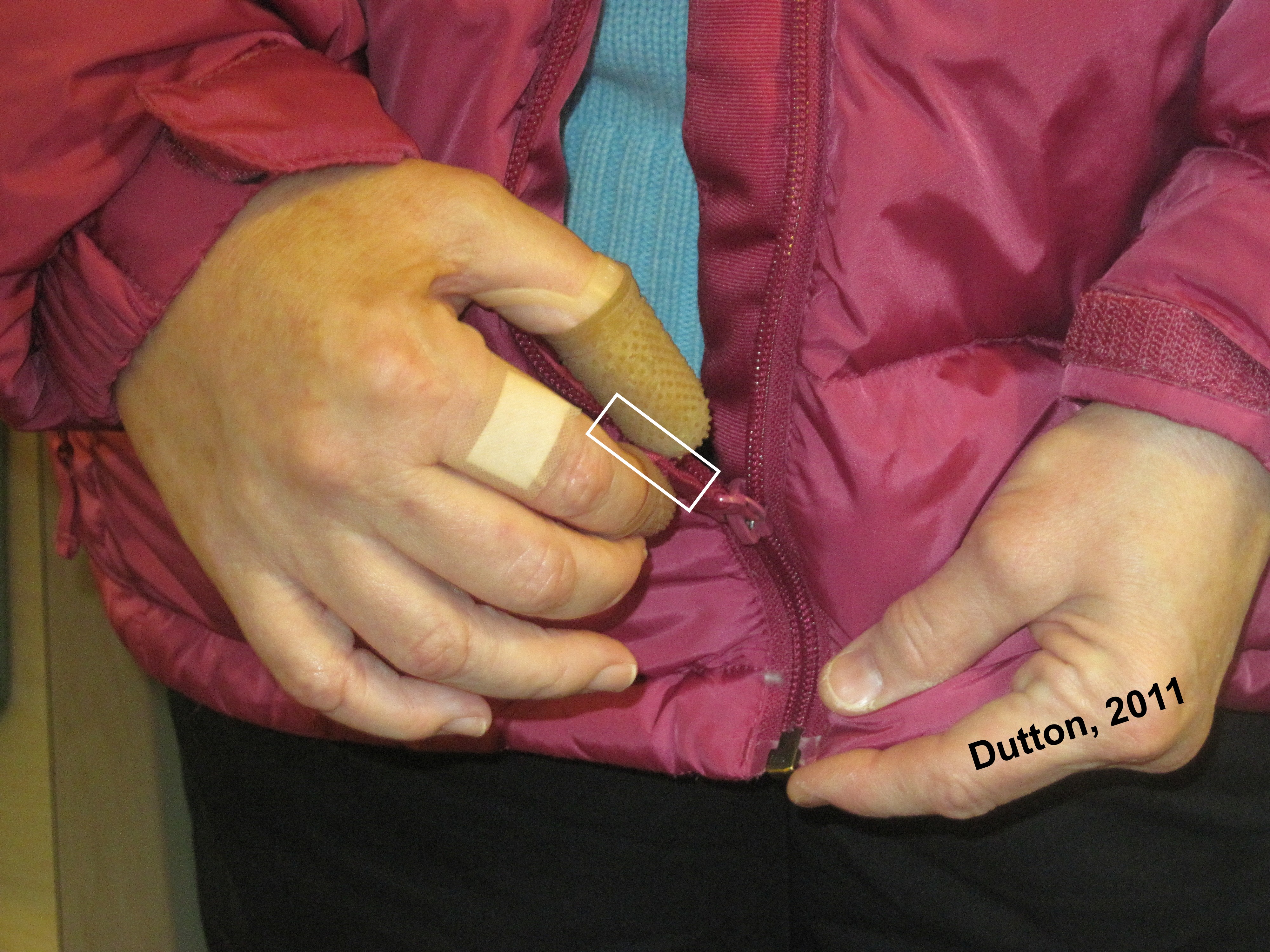
Velcro tabs do not keep me warm.  When I sit in the car, gaps form between the Velcro tabs which lets body heat escape.  Connecting the two halves of the zipper are relatively easy.  My right affected hand only needs a gross grasp to hold the female end of the zipper still while my left sound hand inserts the male end in its slot.                                                                            Challenge #1.  Zipper teeth do not mesh together if they are not perfectly aligned.  Only my sound hand can keep the two sides of the zipper perfectly aligned after they are joined so I can zip my coat  (see next 2 photos). 
Arrows show my sound index finger pushing up on the bottom of my coat to keep the zipper joined.  My sound thumb and middle finger pinch the bottom of the coat to hold it still as I  zip.  My affected hand pulls on the fabric zipper tab (white rectangle).     

After I broke my forearm I lost the tip pinch needed to grasp the fabric tab on the end of the zipper.  I attached one end of a tiny carabiner in the hole of the metal zipper tab (S-biner, size 2 from Home Depot).          I insert my hemiplegic index finger in the other hole of the carabiner and pull the zipper up a few inches.  The top photo shows my current coat has a zipper ring so I no longer need a carabiner.

Challenge #2.  My affected hand can pull the zipper tab up only two inches.  Going higher forces my wrist to bend due to the flexion synergy.  After two inches I switch hand positions.  My affected palm presses against my stomach to keep the bottom of the coat still while my sound hand finishes the zipping.  I unhook the carabiner and put it in my coat pocket so it is not visible at front of my neck.  homeafterstroke.blogspot.com

How I Feel Less Guilty About Asking For Help

I live alone so I am both a stroke survivor and a caregiver.   I use 7 strategies to keep my volunteers from burning out (18 years) and feel less guilty about asking for help.

1. Prioritize.  I cut down the number of requests by identifying what I need versus what I want.  I need someone to get on a ladder to change the batteries in my smoke detectors.

2. Build trust.  People do not need special training to know they are being taken advantage of.  When I ask for help I let my volunteers know I do everything I can before I contact them.  People feel good about helping when they know they are really needed.  This strategy builds trust.

3. My husband would groan rule.  I cannot ask people to do things that would make a husband groan.  I cannot ask someone to buy a live tree, transport it, drag it into my house, use an ax to trim the base so the tree fits in the stand, and tighten and loosen the tree stand to reposition the tree until it is straight.  So I bought an artificial tree.  John takes it out of the box and snaps the four pieces together.

4. Let them choose WHAT to volunteer for.  I e-mail a request and let people choose things they want to do.  Peggy who loves to sews repaired the sleeve on my raincoat.  Barbara who is a computer technician volunteered to help me set up the router for my internet service.  Letting people choose what to do means I do not risk rejection because I have asked the wrong person.

5. Let them choose WHEN to volunteer.  After they volunteer I ask them when would be a good time for them.  Everyone has busy lives so it is less of a burden when I fit into their schedule.

6. Make a list and stick to it.  Before someone comes I make a list of the things I need done so my volunteer knows when he or she is done.  I stick to the list instead of looking around and saying "there is one more thing I need you to do."  This list also reminds me to get materials my volunteers need.  Before John comes to replace the batteries in my smoke detectors I buy 9-volt batteries.

7. 80% rule.  The 80% rule means some things can be mostly correct rather than perfect.  After my stroke I gave myself permission to not make everything perfect.  For example, the seam of my bedspread is supposed to be where the edge of the mattress is (see the black line).
It is only fair to extend the 80% rule to my volunteers.  Nobody wants to hear that they did not do it the way I used to do it.
homeafterstroke.blogspot.com

Finally - Real Help for Caregivers

As an OT, I sat through discharge meetings where caregivers were silent.  Some may have been too stunned to ask questions.  Others may have thought problems would disappear because the stroke survivor would completely recover (1).  Reality may not set in until caregivers struggle to get a family member inside his or her home.  I learned how intense demands are on caregivers after I went home alone after a stroke.  After 17 years, I know how many caregiver tasks have to be done to keep a stroke survivor out of a long-term care facility. 

I was excited when I read about a caregiver questionaire that is given before a stroke survivor is discharged from rehab (2).  Before the client goes home, staff ask caregivers what they were thinking as they answered each question.  This creates an opportunity to change what caregivers know and encourage them to ask for help before they get into trouble.  A dialogue is so much better than handouts.   homeafterstroke.blogspot.com

1.  Lutz B et al. Improving stroke caregiver readiness for transition from inpatient rehabilitation
        to home. The Gerontologist. 2016; Vol 00:No.00,1-10. doi10.1093/geront/gnw135.                    2. Camicia M, Lutz B, Harvath T, Joseph, J.  Using the Preparedness Assessment for the                    Transition Home After Stroke Instrument to identify stroke caregiver concerns predischarge:            Uncertainty, anticipation, and cues to action.  Rehabil Nurs. 2021 Jan-Feb 46(1):33-42.

The Final Shoe Solution

Being forced to stay home during the covid-19 pandemic helped me remember why I work so hard to solve problems caused by my leg brace and shoes.  I would be severely depressed if I had lacked the confidence to walk safely in the community during the 16 years since my stroke.

Neither the white duct tape in the photo or double-sided tape have glue strong enough to stop my leg brace from pushing the shoe insert out of place.  When the shoe insert slides to one side my foot tilts so most of my weight is on the outside edge of my hemiplegic foot (ankle inversion).  Walking on a foot that is not flat is unsafe and tiring.  I am currently using T-Rex Ferousiously Strong double-sided mounting tape to see if it keeps the shoe insert in the center of the shoe.

Long socks that reach the knee prevent skin chafing as the brace rubs the top of the calf.  However, the only knee-high socks made for women are brightly colored socks used during soccer.
I cut the top off a man's white tube sock so it covers the top my calf.  I have washed them many times.  They fray eventually but hold together for a long time.  I am happy that what people see is black socks with black shoes and beige socks with beige shoes.


My THICK leg brace creates a leg-length discrepancy by making my hemiplegic leg longer than my sound leg.  Wearing 2 socks on my sound foot makes my sound leg a little longer.  The 2nd sock also keeps my foot from sliding inside the extra wide shoes
I need to accomodate my brace.  Having my sound foot slide inside my shoe makes walking tiring and puts strain on my hip and knee.  I wish I had known about this 2 sock solution before my sound knee needed joint replacement surgery.


The long sock I pull over the short ankle sock gets stretched out which makes it easier to don.  I bought permanent ink pens to mark the stretched sock in each pair.  A black pen works for white and beige socks.  The silver pen I use on black socks fades in the wash so I have to repeatedly mark them.

If you read this entire post you may understand why I do not think this is my last post about my shoes.   homeafterstroke.blogspot.com